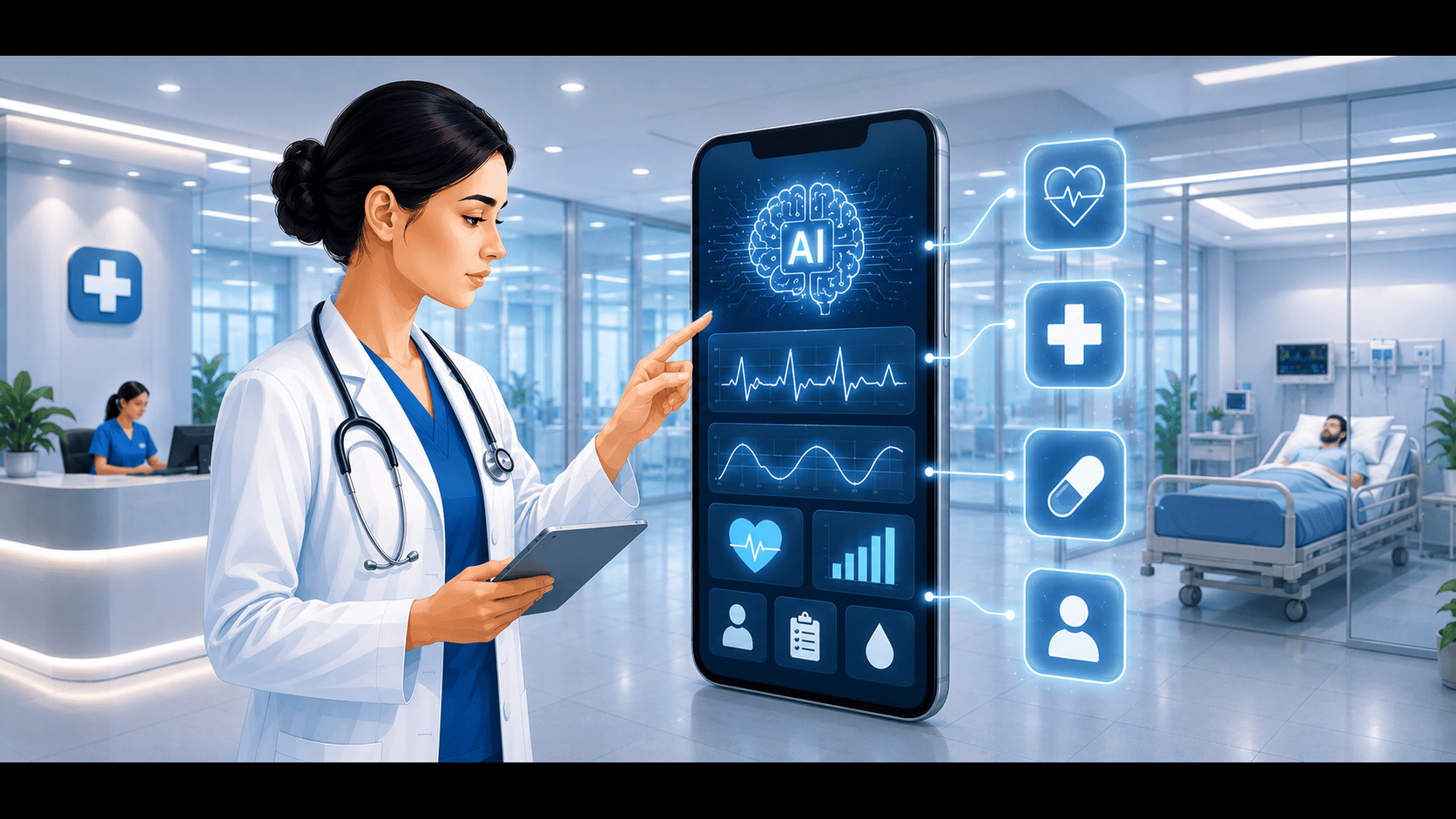


Artificial intelligence (AI) is changing healthcare fast. Today, hospitals, clinics, startups, and health tech companies use AI to build smarter healthcare apps. These apps help doctors make better decisions, reduce errors, save time, and improve patient care.
From virtual health assistants to AI diagnosis tools, healthcare apps are becoming more intelligent every year.
What Is AI in Healthcare App Development?
AI in healthcare app development means using artificial intelligence technologies inside healthcare applications to automate tasks, analyse data, predict outcomes, and improve patient experiences.
AI healthcare apps can:
- Analyze medical images
- Predict diseases
- Track patient health
- Automate hospital workflows
- Offer personalized treatment
- Improve remote patient monitoring
AI systems learn from healthcare data and improve over time.
Why AI Is Important in Healthcare Apps
Healthcare generates huge amounts of data every day. Doctors and hospitals often struggle to process this information quickly.
AI solves this problem.
AI helps healthcare apps:

AI allows healthcare professionals to focus more on patient care instead of repetitive tasks.
Top AI Use Cases in Healthcare App Development
1. AI-Powered Medical Diagnosis Apps
AI can help doctors detect diseases early.
Healthcare apps use machine learning models to analyse:
- X-rays
- MRI scans
- CT scans
- Blood reports
- Symptoms
Example Use Cases
- Cancer detection
- Heart disease prediction
- Diabetes risk analysis
- Skin disease identification
Benefits
- Faster diagnosis
- Better accuracy
- Early disease detection
- Reduced medical errors
Real-World Example
Google DeepMind developed AI systems that can detect eye diseases from retinal scans with high accuracy.
2. AI Chatbots for Healthcare
AI chatbots help patients get support anytime.
These chatbots answer common questions and guide users.
Common Features
- Appointment booking
- Symptom checking
- Medication reminders
- Mental health support
- Health tips
Benefits
- 24/7 patient support
- Reduced hospital workload
- Faster communication
- Improved patient experience
Example
Healthcare apps like Babylon Health use AI chatbots for virtual consultations.
3. Remote Patient Monitoring Apps
AI helps monitor patients outside hospitals.
These apps connect with wearable devices and smart sensors.
What AI Tracks
- Heart rate
- Blood pressure
- Oxygen levels
- Sleep patterns
- Glucose levels
Benefits
- Real-time monitoring
- Early alerts
- Better chronic disease management
- Reduced hospital visits
Best For
- Elderly care
- Diabetes patients
- Cardiac patients
- Post-surgery recovery
4. AI in Mental Health Apps
Mental health apps use AI to provide emotional support and therapy assistance.
AI Features
- Mood tracking
- Emotion detection
- Guided meditation
- CBT therapy support
- Stress analysis
Benefits
- Easy access to support
- Lower therapy costs
- Better emotional tracking
- Personalized recommendations
Popular Examples
- Woebot
- Wysa
5. AI-Based Drug Discovery Apps
Drug research takes years and costs billions.
AI speeds up this process.
AI Helps By
- Analyzing chemical compounds
- Predicting drug effectiveness
- Reducing testing time
- Finding treatment patterns
Benefits
- Faster drug development
- Lower research costs
- Better success rates
This became very important during COVID-19 vaccine development.
6. AI Virtual Health Assistants
Virtual assistants act like digital healthcare helpers.
Tasks They Perform
- Schedule appointments
- Send reminders
- Track symptoms
- Answer patient questions
- Provide treatment guidance
Benefits
- Better patient engagement
- Improved communication
- Time savings for doctors
7. AI in Medical Imaging Apps
Medical imaging apps use AI to detect abnormalities.
AI Can Analyze
- Brain scans
- Lung scans
- Mammograms
- Bone fractures
Benefits
- High-speed image analysis
- Improved radiology support
- Better accuracy
- Reduced diagnostic delays
8. Predictive Analytics in Healthcare Apps
Predictive analytics helps healthcare providers make proactive decisions.
AI Predicts
- Disease outbreaks
- Hospital readmissions
- Patient deterioration
- Treatment outcomes
Benefits
- Preventive healthcare
- Better resource planning
- Lower emergency cases
9. Personalized Treatment Apps
AI can create treatment plans based on patient data.
AI Uses
- Medical history
- Genetics
- Lifestyle data
- Symptoms
- Medication response
Benefits
- Customized healthcare
- Better treatment success
- Improved patient outcomes
10. AI in Fitness and Wellness Apps
Fitness apps use AI to deliver personalised health recommendations.
Common Features
- Smart workout plans
- Diet recommendations
- Sleep tracking
- Activity monitoring
Benefits
- Better fitness goals
- Improved engagement
- Personalized wellness plans
Benefits of AI in Healthcare App Development
Faster Healthcare Services
AI reduces manual work and speeds up processes.
Doctors can diagnose faster. Patients get support quickly.
Improved Accuracy
AI reduces human mistakes.
This helps in:
- Disease detection
- Medical imaging
- Prescription management
Better Patient Experience
Patients expect fast and personalised healthcare.
AI improves:
- Communication
- Accessibility
- Convenience
- Support availability
Lower Operational Costs
Healthcare organisations save money through automation.
AI reduces:
- Administrative work
- Repetitive tasks
- Resource waste
Enhanced Data Management
Healthcare apps handle huge amounts of data. AI helps organise and analyse medical records effectively.
Personalized Healthcare
AI provides tailored treatments and recommendations based on individual patient data.
24/7 Healthcare Support
AI chatbots and assistants work all day without breaks. Patients can access help anytime.
Key Technologies Used in AI Healthcare Apps

Challenges in AI Healthcare App Development
AI offers many benefits, but there are also challenges.
Data Privacy and Security
Healthcare data is sensitive.
Solution
- HIPAA compliance
- Data encryption
- Secure cloud storage
High Development Costs
AI healthcare apps can be expensive to build.
Solution
Start with an MVP and scale gradually.
Regulatory Compliance
Healthcare apps must follow strict regulations.
Important Standards
- HIPAA
- GDPR
- FDA regulations
AI Bias
Poor-quality data can create biased AI predictions.
Solution
Use diverse and accurate training datasets.
Integration Issues
Healthcare systems often use old technologies.
Solution
Use APIs and cloud-based integration systems.
How to Build an AI Healthcare App
Step 1: Identify the Healthcare Problem
Focus on solving a real patient or hospital challenge.
Examples:
- Long wait times
- Poor monitoring
- Diagnostic delays
Step 2: Choose the Right AI Technology
Select technologies based on the app goal.

Step 3: Ensure Compliance
Follow healthcare laws from the beginning.
Step 4: Design a User-Friendly Interface
Healthcare apps should be simple and easy to use.
Step 5: Train AI Models
Use quality healthcare datasets.
Better data = better AI performance.
Step 6: Test Thoroughly
Healthcare apps require strong testing for:
- Accuracy
- Security
- Performance
- Compliance
Future Trends of AI in Healthcare App Development
AI healthcare technology is growing rapidly.
Generative AI in Healthcare
AI can generate medical summaries and automate documentation.
Voice AI for Healthcare
Doctors may use voice assistants for faster patient record updates.
AI + Blockchain
This improves healthcare data security.
Digital Twins
AI may create virtual patient models for personalised treatment simulation.
Hyper-Personalized Medicine
AI will provide more customised healthcare plans.
AI in Healthcare App Development: Real Business Impact
Many healthcare companies already use AI successfully.

These companies show how AI improves healthcare outcomes and efficiency.
Why Businesses Should Invest in AI Healthcare Apps
Healthcare demand is increasing worldwide.
Patients expect:
- Faster service
- Remote care
- Personalized healthcare
- Better digital experiences
AI helps businesses meet these expectations.
Key Business Benefits
- Competitive advantage
- Better patient retention
- Higher efficiency
- Improved healthcare quality
- Increased revenue opportunities
Best Practices for AI Healthcare App Development
Focus on Real User Problems
Build solutions that solve actual healthcare issues.
Use Explainable AI
Doctors should understand how AI makes decisions.
Keep the Interface Simple
Healthcare apps should be accessible for all age groups.
Prioritize Security
Protect patient data at every stage.
Continuously Improve AI Models
AI systems need regular updates and retraining.
FAQ: AI in Healthcare App Development
1. What is AI in healthcare app development?
AI in healthcare app development means integrating artificial intelligence into healthcare applications to improve diagnosis, patient care, automation, and data analysis.
2. How does AI improve healthcare apps?
AI improves healthcare apps by increasing accuracy, automating tasks, providing predictive insights, and improving patient engagement.
3. What are the top AI healthcare app use cases?
Top use cases include:
- Medical diagnosis
- Chatbots
- Remote monitoring
- Mental health support
- Medical imaging
- Predictive analytics
4. Are AI healthcare apps secure?
Yes, if developers follow healthcare compliance standards like HIPAA and GDPR.
5. What technologies are used in AI healthcare apps?
Common technologies include:
- Machine Learning
- NLP
- Computer Vision
- Deep Learning
- IoT
6. Can AI replace doctors?
No. AI supports doctors but does not replace human medical expertise.
7. How much does AI healthcare app development cost?
The cost depends on features, AI complexity, integrations, compliance needs, and app scale.
8. What are the biggest challenges in AI healthcare app development?
Main challenges include:
- Data privacy
- Compliance
- High development costs
- AI bias
- System integration
9. Why is AI important for the future of healthcare?
AI helps improve healthcare quality, accessibility, speed, personalisation, and operational efficiency.
Conclusion
AI in healthcare app development is transforming modern healthcare.
From diagnosis to patient monitoring, AI-powered healthcare apps improve efficiency, accuracy, and patient experiences.
Healthcare organisations that adopt AI early can:
- Deliver better care
- Reduce costs
- Improve operations
- Stay competitive
The future of healthcare will depend heavily on intelligent, data-driven, and personalised digital solutions.
AI is no longer optional in healthcare innovation. It is becoming essential.
Looking to build an AI-powered healthcare app?
Partner with an experienced healthcare app development company that understands:
- AI integration
- Healthcare compliance
- User-focused design
- Secure architecture
- Scalable healthcare solutions
Start building smarter healthcare experiences today.