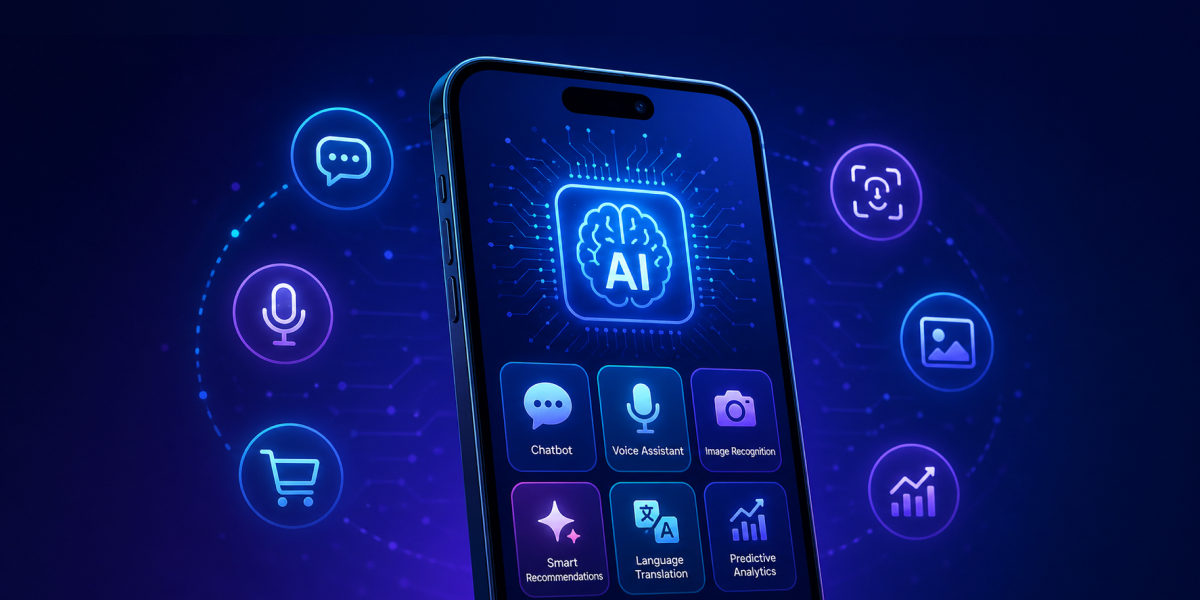


The top must-have features of an AI-powered mobile app are: AI chatbot for 24/7 support, personalised recommendation engine, predictive analytics, voice recognition, computer vision, real-time fraud detection, smart push notifications, NLP-powered search, automated workflows, and continuous learning from user behaviour. Apps with these AI features see up to 35% higher user retention, 40% lower support costs, and 30–50% better conversion rates compared to traditional mobile apps.
Top features of AI-powered mobile applications include:
- Personalization
- AI chatbots
- Predictive analytics
- Image & voice recognition
- Real-time processing
- Smart security
- Automation
- Natural language processing
These features help apps learn, adapt, and improve user experience automatically
Introduction
Most mobile apps fail for one reason:
They don’t feel smart.
Users today expect apps that:
- Understand their needs
- Respond instantly
- Improve over time
But many businesses still build apps that are the following:
- Static
- Generic
- Slow
Result: Low engagement and high uninstall rates
Based on real-world AI app development projects, one thing is clear:
Apps with the right AI features consistently outperform traditional apps
In this guide, you’ll learn:
- The most important AI features
- How they work in real apps
- How to implement them the right way
This is why businesses are investing in AI-powered mobile app solutions
What Is an AI-Powered Mobile Application?
An AI-powered app uses data and algorithms to:
- Learn from user behavior
- Predict actions
- Automate decisions
Real-World Examples:
- Netflix → content recommendations
- Amazon → product suggestions
- Uber → dynamic pricing
👉 These apps don’t just function
👉 They continuously improve
Traditional Apps vs AI Apps

Top Features of AI-Powered Mobile Applications
1. Personalized User Experience
Problem:
Why does your app fail to show relevant content to each user?
Solution:
Use AI to track user behaviour like clicks, searches, and time spent. Apply recommendation algorithms to show relevant content for each user.
👉 This ensures every user sees content that matches their interests, increasing engagement and time spent in the app.
How to Implement:
- Track user actions (clicks, time spent)
- Use recommendation algorithms
- Continuously update suggestions
Real Case Insight:
In e-commerce apps, AI personalisation engines can increase conversion rates by 30–50%.
Why it matters:
👉 Users see what they want → higher engagement
2. AI Chatbots & Virtual Assistants
Problem:
Why is your customer support slow and unable to respond instantly?
Solution:
Implement AI chatbots with natural language processing for instant replies.Train them using FAQs and real user queries to improve response accuracy.
👉 As a result, users get quick support anytime, improving satisfaction and reducing support workload.
How to Implement:
- Use NLP-based chatbot systems
- Train with FAQs and user queries
- Integrate with backend systems
Real Case Insight:
Banking apps reduce customer support costs by up to 40% using AI chatbots.
Why it matters:
👉 Faster support → better experience
3. Predictive Analytics
Problem:
Why are you unable to predict user behaviour and future actions?
Solution:
Use historical user data to identify patterns and trends. Apply machine learning models to predict user actions and future behavior.
👉 This helps businesses take proactive decisions instead of reacting too late.
How to Implement:
- Use historical data
- Apply machine learning models
- Identify patterns
Real Case Insight:
Streaming apps like Netflix use predictive models to improve retention by recommending content.
Why it matters:
👉 Better decisions → higher retention
4. Image & Voice Recognition
Problem:
Why is your app interaction still dependent on slow manual input?
Solution:
Integrate speech recognition and image processing APIs into your app. Allow users to interact using voice commands or visual search features.
👉 This makes app interaction faster, easier, and more user-friendly.
How to Implement:
- Use speech recognition APIs
- Use image recognition models
- Integrate with mobile UI
Real Case Insight:
Retail apps using visual search improve product discovery and user engagement.
Why it matters:
👉 Faster actions → better usability
5. Real-Time Data Processing
Problem:
Why does your app fail to respond instantly to user actions?
Solution:
Use real-time data pipelines and cloud-based processing systems. Ensure your app updates instantly based on live user activity.
👉 This enables faster responses and improves overall app performance.
How to Implement:
- Use real-time data pipelines
- Integrate streaming data systems
- Optimize backend architecture
Real Case Insight:
Ride-sharing apps adjust pricing and availability in real time using AI.
Why it matters:
👉 Instant response → better experience
6. Smart Security & Fraud Detection
Problem:
Why is your app unable to detect threats and fraud in real time?
Solution:
Implement AI-based anomaly detection to monitor unusual behavior. Use real-time alerts to prevent fraud and protect user data.
👉 Strong security builds user trust and protects sensitive information.
How to Implement:
- Monitor user behavior
- Use anomaly detection models
- Trigger alerts
Real Case Insight:
Fintech apps detect fraud by analysing transaction patterns in real time.
Why it matters:
👉 Security builds trust
7. Intelligent Automation
Problem:
Why are your business processes still manual and time-consuming?
Solution:
Automate repetitive tasks using AI-driven workflows and systems. Reduce manual work and improve efficiency with smart automation tools.
👉 This saves time, reduces errors, and improves productivity.
How to Implement:
- Automate workflows
- Use AI decision systems
- Integrate backend automation
Real Case Insight:
Automation improves operational efficiency by 20–30% in many apps.
Why it matters:
👉 Saves time and cost
8. Smart Navigation & Recommendations
Problem:
Why do users struggle to find what to do next in your app?
Solution:
Use AI to analyse user journeys and behaviour patterns. Provide personalised suggestions to guide users through the app.
👉 This helps users take action faster and improves overall engagement.
How to Implement:
- Use recommendation engines
- Analyze user journeys
- Provide contextual suggestions
Real Case Insight:
Music apps increase session time with AI-based playlists.
Why it matters:
👉 Better journey → more engagement
9. Natural Language Processing (NLP)
Problem:
Why does your app fail to understand user queries and intent?
Solution:
Use NLP models to understand user queries and intent accurately. Enable voice and text interactions for better communication.
👉 This creates a more human-like and seamless user experience.
How to Implement:
- Use NLP models
- Train on user queries
- Integrate voice and text
Real Case Insight:
Voice assistants improve accessibility and user interaction.
Why it matters:
👉 Human-like experience
10. Continuous Learning & Improvement
Problem:
Why does your app fail to improve and adapt over time?
Solution:
Continuously collect user data and feedback for improvement. Update AI models regularly to enhance performance and accuracy.
👉 Over time, the app becomes smarter and delivers better results.
How to Implement:
- Collect user feedback
- Update models regularly
- Improve accuracy
Real Case Insight:
Apps using continuous learning improve retention over time.
Why it matters:
👉 Long-term growth
Mini Case Study
Real Impact of AI Features:
- 🛒 E-commerce app → +35% conversions using recommendations
- 🏦 Banking app → -40% support cost using chatbots
- 🏃 Fitness app → +50% retention using personalization
👉 These are consistent results seen across AI-powered apps
Who Should Use AI-Powered Apps?
- Startups → faster scaling
- Healthcare → smarter care
- E-commerce → higher sales
- Finance → better security
- SaaS → automation
Why Many AI Apps Still Fail
- No clear problem
- Overcomplicated features
- Poor UX
- Low-quality data
👉 AI success depends on execution, not just technology
FAQs
What are AI-powered mobile applications?
AI-powered mobile applications are apps that use artificial intelligence to learn, predict, and automate tasks.
They analyse user behaviour, improve over time, and deliver smarter experiences like recommendations, automation, and real-time responses.
What features make an AI app successful?
Successful AI apps include features like personalisation, automation, predictive analytics, and real-time data processing.
These features help apps understand users better, respond instantly, and continuously improve performance and engagement.
Why are AI apps important?
AI apps are important because they improve user experience and business performance.
They help businesses automate tasks, reduce costs, and deliver faster, more accurate, and personalized services to users.
Which industries benefit from AI apps?
Industries like healthcare, finance, e-commerce, and education benefit the most from AI apps.
They use AI for automation, personalisation, decision-making, and improving efficiency across operations and user interactions.
Final Thoughts
AI-powered mobile applications are no longer optional.
They are a competitive advantage.
But here’s the truth from real-world projects:
The success of an AI app depends on choosing the right features—not adding everything
The best apps are:
- Focused
- Simple
- User-driven
👉 If your app solves real problems, users stay. If not, they leave quickly
Ready to Build an AI-Powered Mobile App?
Looking for an AI mobile app development company? Don’t just build another app.
👉 Build an intelligent system that grows with your users