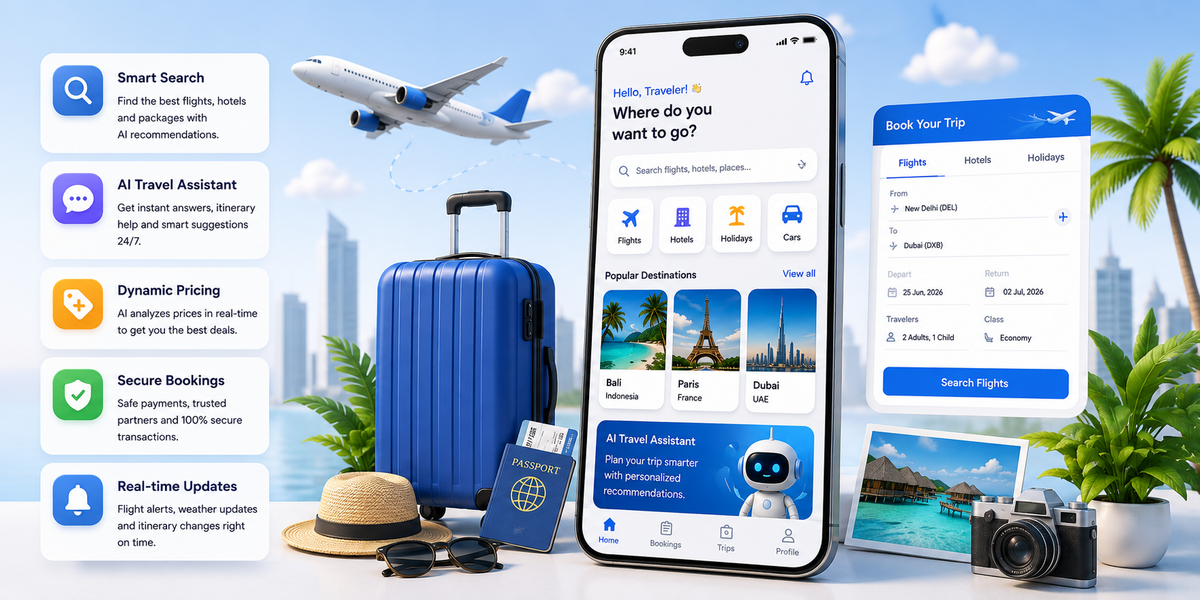


AI-powered travel booking apps use artificial intelligence to personalize trip planning, automate bookings, recommend destinations, predict prices, provide 24/7 AI assistance, and improve customer experiences. Businesses benefit from higher conversions, lower operational costs, and smarter decision-making, while travelers enjoy faster booking, personalized recommendations, and real-time travel support.
What is an AI-powered travel booking app?
An AI-powered travel booking app is a travel application that uses artificial intelligence to help users search, compare, and book flights, hotels, holiday packages, transportation, and activities. AI also provides personalised recommendations, dynamic pricing insights, itinerary planning, multilingual support, and 24/7 virtual assistance to improve the travel experience.
The Future of Travel Is Powered by AI
The travel industry is changing quickly.
Travellers no longer want to spend hours comparing hundreds of flights, hotels, and vacation packages.
They expect personalised recommendations, instant bookings, real-time updates, and fast customer support.
Businesses face challenges too.
Travel companies must manage thousands of bookings, changing prices, customer questions, cancellations, and travel disruptions every day.
Traditional travel applications struggle to keep up with these growing expectations.
This is where AI-powered travel booking apps make a difference.
Artificial intelligence helps travel businesses automate routine work, personalise customer experiences, predict traveller preferences, and improve booking efficiency.
Instead of acting as a simple booking platform, an AI-powered travel app becomes a smart travel assistant that supports users before, during, and after their trip.
Whether you are building an online travel agency (OTA), airline platform, hotel booking application, or complete travel marketplace, AI can help deliver better experiences while reducing operational costs.
What Is an AI-Powered Travel Booking App?
An AI-powered travel booking app is a mobile or web application that combines travel booking services with artificial intelligence to deliver smarter, faster, and more personalised travel experiences.
Unlike traditional booking platforms that only display search results, AI-powered apps understand customer preferences, analyse travel patterns, and recommend the best options automatically.
These applications can help users:
- Search flights
- Book hotels
- Reserve rental cars
- Plan complete vacations
- Build travel itineraries
- Discover attractions
- Find restaurants
- Receive travel alerts
- Get AI-powered customer support
Instead of requiring users to search through hundreds of listings, the AI engine filters options based on preferences, budget, travel history, and current trends.
For example, if a user frequently books family vacations near beaches with a mid-range budget, the AI system can prioritize similar recommendations for future trips.
This creates a faster, more personalised booking experience.
How AI-Powered Travel Apps Work
A modern AI travel application combines multiple technologies to deliver intelligent recommendations and automate workflows.
A typical booking journey looks like this:

Unlike traditional travel apps, AI continuously learns from user interactions to improve future recommendations.
Traditional Travel Apps vs AI-Powered Travel Apps

Why AI Is Transforming the Travel Industry
The travel industry has become highly competitive.
Customers have more choices than ever before.
They compare multiple websites before making a booking.
If they cannot find the right option quickly, they often leave the platform.
AI helps solve this challenge by making travel planning faster, simpler, and more relevant.
Instead of overwhelming users with hundreds of results, AI recommends the options most likely to match their needs.
1. Travelers Expect Personalization
Modern travellers want experiences tailored to their interests.
For example:
- Adventure travellers look for hiking and outdoor activities.
- Families prefer child-friendly hotels.
- Business travellers need flexible schedules.
- Luxury travellers expect premium experiences.
- Budget travellers prioritise affordability.
AI analyses customer preferences and recommends relevant options automatically.
2. Booking Decisions Need to Be Faster
Travel prices change frequently.
Flights and hotels can become more expensive within hours.
AI helps users by:
- Tracking price changes
- Predicting fare trends
- Suggesting the best time to book
- Alerting users when prices drop
This helps travellers save money while increasing booking confidence.
3. Customer Support Is Available 24/7
Travel issues don't follow office hours.
Customers may need help with:
- Flight delays
- Hotel changes
- Visa information
- Booking modifications
- Refund requests
- Local transportation
AI assistants provide instant support at any time, improving customer satisfaction while reducing support costs.
4. Better Business Decisions
Travel companies generate large amounts of data every day.
AI helps businesses analyse:
- Booking trends
- Seasonal demand
- Customer behavior
- Popular destinations
- Revenue patterns
- Marketing performance
These insights help companies make better strategic decisions.
5. Increased Revenue Opportunities
AI identifies opportunities to increase revenue by recommending complementary services.
Examples include:
- Hotel upgrades
- Airport transfers
- Travel insurance
- Local tours
- Restaurant reservations
- Premium seating
- Car rentals
This personalised upselling improves the customer experience while increasing average booking value.
Key Features of an AI-Powered Travel Booking App
A successful AI-powered travel booking app should deliver value before, during, and after the trip.
Below are the essential features that modern travellers expect.
1. AI-Powered Smart Search
Traditional search relies on exact keywords.
AI search understands user intent.
Instead of typing "cheap hotel in Paris", users can ask:
"Find a family-friendly hotel near the Eiffel Tower under $200."
The AI interprets the request and delivers highly relevant results.
Benefits
- Faster search
- More accurate recommendations
- Better user experience
- Higher booking conversions
2. Personalized Travel Recommendations
AI analyses user behaviour, booking history, budget, and interests to suggest personalised travel options.
Examples include:
- Destinations
- Hotels
- Flights
- Vacation packages
- Local attractions
- Restaurants
- Activities
As users interact with the app, recommendations become more accurate over time.
3. AI Travel Assistant
A built-in AI assistant acts like a digital travel companion.
It can help users:
- Plan trips
- Compare flights
- Recommend hotels
- Answer travel questions
- Update bookings
- Provide local suggestions
- Share weather forecasts
- Offer travel tips
This reduces the need for manual customer support and improves the overall experience.
4. Intelligent Itinerary Planning
Planning a trip manually takes time.
AI simplifies this by automatically creating a day-by-day itinerary based on:
- Travel dates
- Interests
- Budget
- Opening hours
- Travel distances
- Local events
Users can customise the itinerary as needed, making trip planning more efficient and enjoyable.
5. Dynamic Price Prediction
Flight and hotel prices change constantly.
AI analyses historical pricing patterns and market trends to help users decide when to book.
It can:
- Predict price increases
- Detect price drops
- Recommend the best booking time
- Send fare alerts
This feature helps travellers make informed decisions and improves trust in the platform.
6. Real-Time Travel Notifications
Travel plans can change unexpectedly.
AI-powered notifications keep users informed about:
- Flight delays
- Gate changes
- Hotel check-in updates
- Weather conditions
- Traffic disruptions
- Travel advisories
Providing timely updates helps travellers stay prepared and reduces travel-related stress.
Benefits of AI-Powered Travel Booking Apps for Businesses
Travel businesses are under pressure to deliver faster service, reduce costs, and stand out in a competitive market. AI-powered travel booking apps help businesses automate operations, improve customer experiences, and increase revenue.
1. Higher Booking Conversions
Many travellers leave a booking because they cannot quickly find the right option.
AI solves this by recommending flights, hotels, and packages based on user preferences.
For example, if a customer frequently books beach vacations, the app can highlight similar destinations and offers.
Business Benefits
- More completed bookings
- Lower cart abandonment
- Personalized offers
- Better customer engagement
2. Lower Customer Support Costs
Travel companies receive thousands of questions every day.
Common questions include:
- Where is my booking?
- Can I cancel my trip?
- Is my flight delayed?
- Which documents do I need?
- Can I change my hotel?
Instead of relying only on human agents, AI assistants answer common questions instantly.
Benefits
- 24/7 customer support
- Faster response times
- Reduced support workload
- Lower operational costs
3. Increased Revenue Through Smart Upselling
AI understands customer preferences and recommends additional services at the right time.
Examples include:
- Hotel room upgrades
- Airport transfers
- Travel insurance
- Guided tours
- Rental cars
- Premium flight seats
- Local attraction tickets
These personalised suggestions improve the travel experience while increasing average booking value.
4. Better Business Insights
AI analyses customer and booking data to uncover trends.
Businesses can understand the following:
- Popular destinations
- Seasonal demand
- Customer demographics
- High-performing packages
- Cancellation trends
- Revenue performance
These insights support better pricing, marketing, and inventory decisions.
5. Automated Operations
AI automates repetitive tasks such as the following:
- Booking confirmations
- Payment verification
- Invoice generation
- Email notifications
- Customer reminders
- Refund requests
- Cancellation workflows
Automation reduces manual effort and improves operational efficiency.
Business Benefits at a Glance

Benefits of AI-Powered Travel Booking Apps for Travelers
Travellers want convenience, speed, and personalised experiences. AI makes every stage of the journey easier—from planning to returning home.
1. Personalized Trip Planning
Every traveller has different interests.
AI creates recommendations based on the following:
- Budget
- Travel history
- Family size
- Preferred destinations
- Food preferences
- Adventure interests
- Luxury expectations
This saves time and reduces decision fatigue.
2. Faster Booking Experience
Instead of comparing hundreds of options manually, AI narrows the choices to the most relevant ones.
Travellers can book complete trips in minutes.
3. Real-Time Travel Assistance
Travel plans often change unexpectedly.
AI provides instant updates about:
- Flight delays
- Gate changes
- Weather alerts
- Hotel check-in updates
- Local traffic
- Visa reminders
This helps travellers stay informed throughout their journey.
4. Better Travel Recommendations
AI recommends experiences that match user interests.
Examples include:
- Local restaurants
- Museums
- Beaches
- Hiking trails
- Family attractions
- Shopping destinations
- Cultural events
Recommendations become more accurate as the system learns from user behaviour.
5. Smarter Budget Management
AI helps travellers save money by:
- Predicting airfare changes
- Comparing hotel prices
- Finding seasonal discounts
- Suggesting affordable travel dates
- Recommending package deals
This enables users to make informed booking decisions.
Technologies Used in AI-Powered Travel Booking App Development
Modern travel apps rely on multiple AI technologies working together.
1. Large Language Models (LLMs)
Large language models enable conversational travel assistants.
They can:
- Answer travel questions
- Suggest destinations
- Explain visa requirements
- Recommend hotels
- Help with itinerary planning
- Modify bookings
Examples include GPT-based and other enterprise LLMs.
2. Machine Learning (ML)
Machine learning identifies patterns in travel data.
It powers:
- Personalized recommendations
- Price prediction
- Customer segmentation
- Booking forecasting
- Demand prediction
- Fraud detection
As more data becomes available, ML models improve over time.
3. Natural Language Processing (NLP)
NLP helps the application understand human language.
Users can ask:
"Find me a family-friendly hotel in Dubai under $200 with free breakfast."
The AI understands the request and returns relevant results.
NLP also powers multilingual customer support and voice interactions.
4. Recommendation Engine
Recommendation engines analyse:
- Previous bookings
- Browsing history
- Search behavior
- Ratings
- Budget
- Travel preferences
The system then recommends the most suitable:
- Flights
- Hotels
- Activities
- Vacation packages
5. Computer Vision
Computer vision enables AI to understand images.
Travel companies use it for:
- Identity verification
- Passport scanning
- Document validation
- OCR for travel documents
- Receipt scanning
This reduces manual verification time.
6. Predictive Analytics
Predictive models estimate future outcomes such as the following:
- Flight price changes
- Hotel demand
- Seasonal travel trends
- Cancellation probability
- Customer lifetime value
Businesses use these insights to improve planning and optimise pricing.
AI Technology Stack

AI-Powered Travel Booking App Development Process
Building an AI-powered travel app requires careful planning, user-focused design, and scalable architecture.
Step 1: Define Business Goals
Start by answering:
- Who are your target users?
- Which services will you offer?
- What business problem are you solving?
- What makes your platform unique?
Clear goals guide every design and development decision.
Step 2: Conduct Market Research
Analyse competitors and identify opportunities.
Study:
- User pain points
- Popular travel features
- Market trends
- Competitor strengths
- Customer expectations
This research helps prioritise the right features.
Step 3: Design the User Experience
Create wireframes and interactive prototypes.
Focus on:
- Simple navigation
- Fast booking flow
- Mobile-first design
- Accessibility
- Clear calls to action
A good user experience reduces drop-offs and increases bookings.
Step 4: Develop Core Features
Implement essential modules such as:
- User authentication
- Flight booking
- Hotel booking
- Payment gateway
- AI recommendation engine
- Chat assistant
- Notifications
- Booking history
Step 5: Integrate AI Capabilities
Add AI features, including:
- Personalized recommendations
- Conversational assistant
- Dynamic pricing
- Itinerary generation
- Smart search
- Predictive analytics
These features differentiate your app from traditional booking platforms.
Step 6: Test and Optimize
Before launch:
- Perform functional testing
- Validate payment flows
- Test AI recommendations
- Measure performance
- Conduct security testing
- Gather beta user feedback
Continuous optimisation ensures a reliable user experience.
Step 7: Launch and Improve
After launch:
- Monitor user behavior
- Track booking conversions
- Collect customer feedback
- Update AI models
- Introduce new features based on user demand
AI applications improve through ongoing learning and refinement.
AI-Powered Travel Booking App Development Cost (2026)
The cost of developing an AI-powered travel booking app depends on:
- Feature complexity
- Platform (iOS, Android, Web)
- AI capabilities
- Third-party integrations
- Team location
- Security and compliance requirements
Estimated Development Cost

*Approximate conversion; actual costs vary with exchange rates and project scope.
Major Cost Factors
AI Features
Advanced capabilities such as recommendation engines, conversational AI, and predictive pricing require additional development and model integration.
Third-Party Integrations
Common integrations include:
- Flight APIs
- Hotel APIs
- Payment gateways
- Maps
- Weather services
- SMS and email notifications
Platform Support
Developing for Android, iOS, and the web increases development effort but reaches a broader audience.
UI/UX Design
A modern, intuitive interface improves engagement and conversion rates and should be considered an essential investment rather than an optional expense.
Security and Compliance
Travel platforms handle personal and payment information, making strong security practices and regulatory compliance critical.
Latest AI-Powered Travel Booking App Trends in 2026
Artificial intelligence is changing how people plan, book, and experience travel. In 2026, AI is no longer just a feature—it is becoming the foundation of modern travel platforms.
Travel companies that adopt AI early can deliver more personalised experiences, improve operational efficiency, and stay competitive in a rapidly evolving market.
Below are the key trends shaping the future of AI-powered travel booking apps.
1. AI Travel Agents
Instead of simply searching for flights or hotels, travellers can now interact with AI travel agents.
Users can ask questions such as the following:
"Plan a 5-day family trip to Bali under $2,000."
The AI agent can:
- Suggest destinations
- Compare flights
- Recommend hotels
- Build a complete itinerary
- Estimate the total budget
- Book services
- Handle changes after booking
Unlike traditional chatbots, AI agents understand context and support users throughout their journey.
2. Hyper-Personalized Travel Experiences
Travellers expect recommendations that match their preferences.
AI analyses:
- Travel history
- Budget
- Favorite destinations
- Preferred airlines
- Hotel ratings
- Seasonal travel habits
- Food preferences
- Activity interests
Based on this information, the app recommends personalised travel experiences instead of generic listings.
3. Voice-Based Travel Booking
Voice AI is becoming more common.
Instead of typing, travellers can say:
"Book the cheapest direct flight to Singapore next Friday."
The AI assistant understands the request, compares options, and guides the user through the booking process.
Voice interactions improve accessibility and make travel planning more convenient.
4. Predictive Pricing
Flight and hotel prices change frequently.
AI analyses:
- Historical pricing
- Demand
- Seasonal trends
- Local events
- Airline pricing behavior
The app can notify users when:
- Prices are likely to increase
- Prices are expected to decrease
- It is the best time to book
This helps travellers save money and make informed decisions.
5. Generative AI for Trip Planning
Generative AI creates complete travel itineraries in seconds.
For example:
Input:
"Plan a romantic honeymoon in Italy for 7 days."
The AI generates:
- Daily itinerary
- Hotel suggestions
- Restaurant recommendations
- Tourist attractions
- Transportation options
- Estimated budget
This saves users significant planning time.
6. AI-Powered Customer Support
Travellers need assistance before, during, and after their trips.
AI assistants can:
- Answer travel questions
- Modify bookings
- Explain visa requirements
- Track refunds
- Provide weather updates
- Share local travel advice
Complex issues are escalated to human support teams when needed.
7. Sustainable Travel Recommendations
Many travellers prefer environmentally responsible options.
AI can recommend:
- Eco-friendly hotels
- Low-emission flights
- Public transportation
- Sustainable travel experiences
This supports more informed travel choices.
Real-World Use Cases of AI-Powered Travel Booking Apps
AI is transforming multiple segments of the travel industry.
Online Travel Agencies (OTAs)
Examples:
- Expedia
- Booking platforms
- Regional travel marketplaces
AI helps by:
- Personalizing search results
- Improving recommendations
- Increasing booking conversions
- Automating customer support
Airlines
AI supports:
- Flight recommendations
- Dynamic pricing
- Seat upgrades
- Baggage assistance
- Check-in reminders
- Delay notifications
Hotel Chains
Hotels use AI for:
- Personalized room recommendations
- Smart pricing
- Automated check-in
- Guest communication
- Upselling premium services
Tour Operators
AI assists with:
- Package recommendations
- Itinerary creation
- Customer engagement
- Travel reminders
- Local activity suggestions
Corporate Travel Management
Businesses use AI to:
- Book employee travel
- Enforce travel policies
- Optimize travel budgets
- Generate expense reports
- Provide travel assistance
Challenges in AI-Powered Travel App Development
AI delivers significant benefits, but successful implementation requires careful planning.
1. Data Privacy
Travel applications process sensitive information, including the following:
- Personal details
- Passport information
- Payment data
- Travel history
Developers should implement:
- End-to-end encryption
- Secure authentication
- Role-based access control
- Data minimization
- Regular security audits
Compliance with applicable privacy regulations is essential.
2. Integration Complexity
Travel apps often integrate with:
- Flight providers
- Hotel booking systems
- Payment gateways
- Maps
- Weather services
- Currency conversion APIs
Reliable API integration is critical for a seamless user experience.
3. AI Accuracy
AI recommendations depend on the quality of the underlying data.
To improve reliability:
- Train models with diverse datasets
- Continuously monitor performance
- Update models regularly
- Include human oversight where appropriate
4. Infrastructure Costs
AI services require computing resources.
Costs may include:
- Cloud hosting
- AI model usage
- Storage
- Monitoring
- API subscriptions
Scalable cloud infrastructure helps balance performance and cost.
5. User Trust
Users need confidence in AI recommendations.
Travel apps should:
- Explain recommendations when appropriate
- Display transparent pricing
- Provide easy access to human support
- Offer clear cancellation and refund policies
Transparency builds long-term trust.
Future of AI in Travel Booking
AI will continue to reshape the travel industry.
Future travel applications are expected to include:
- Autonomous AI travel agents that plan and manage entire trips.
- Multi-agent systems coordinating flights, hotels, transportation, and activities.
- Augmented reality navigation for travellers.
- Digital travel companions that provide personalised assistance throughout the journey.
- More accurate demand forecasting and pricing optimisation.
- Deeper personalisation using real-time contextual data.
The future is not about replacing travel experts—it is about helping businesses and travellers make smarter, faster decisions with AI.
Frequently Asked Questions
What is an AI-powered travel booking app?
An AI-powered travel booking app uses artificial intelligence to help users search, compare, book, and manage travel more efficiently while providing personalised recommendations and automated assistance.
How does AI improve travel booking?
AI improves travel booking by personalising recommendations, predicting prices, automating customer support, creating itineraries, and simplifying booking decisions.
What features should an AI travel booking app include?
Key features include the following:
- AI-powered search
- Personalized recommendations
- AI travel assistant
- Dynamic pricing
- Smart itinerary planning
- Real-time notifications
- Secure payments
- Booking management
- Reviews and ratings
How much does AI-powered travel booking app development cost?
Development costs vary based on project complexity.
Typical ranges include the following:
- MVP: $25,000–$50,000
- Mid-level platform: $50,000–$100,000
- Enterprise solution: $100,000–$300,000+
Which AI technologies are used in travel apps?
Modern travel apps commonly use the following:
- Large Language Models (LLMs)
- Machine Learning
- Natural Language Processing (NLP)
- Recommendation Engines
- Predictive Analytics
- Computer Vision
Can AI replace travel agents?
AI can automate repetitive tasks and provide personalised assistance, but experienced travel professionals remain valuable for complex itineraries, exceptional customer service, and unique travel requirements.
Is AI suitable for small travel businesses?
Yes. Many AI capabilities can be introduced gradually, allowing startups and small agencies to improve customer experience, automate routine work, and compete more effectively.
Conclusion
Travel is becoming more digital, personalised, and intelligent. Today's travellers expect instant responses, tailored recommendations, seamless bookings, and real-time assistance throughout their journey.
AI-powered travel booking apps meet these expectations by combining automation, personalisation, and data-driven insights. From smart search and dynamic pricing to AI travel assistants and predictive analytics, these applications help businesses deliver better experiences while improving operational efficiency.
Whether you are building an online travel agency, hotel booking platform, airline application, or complete travel marketplace, investing in AI can create long-term value for both your business and your customers.
The most successful travel platforms in 2026 will not simply enable bookings—they will understand traveller preferences, anticipate needs, and provide meaningful assistance before, during, and after every trip.
Ready to Build an AI-Powered Travel Booking App?
If you're planning to develop a next-generation travel platform, now is the ideal time to integrate AI into your product strategy.
At Infinijith, we design and build intelligent travel solutions tailored to your business goals. Our expertise includes AI-powered travel booking apps, smart recommendation engines, conversational AI assistants, itinerary planners, dynamic pricing systems, and scalable cloud-native platforms.
Whether you're a startup launching a new travel product or an established travel company modernising your services, our team can help you create secure, scalable, and user-focused AI applications.
Contact Infinijith today to discuss your project and discover how AI can transform your travel business.