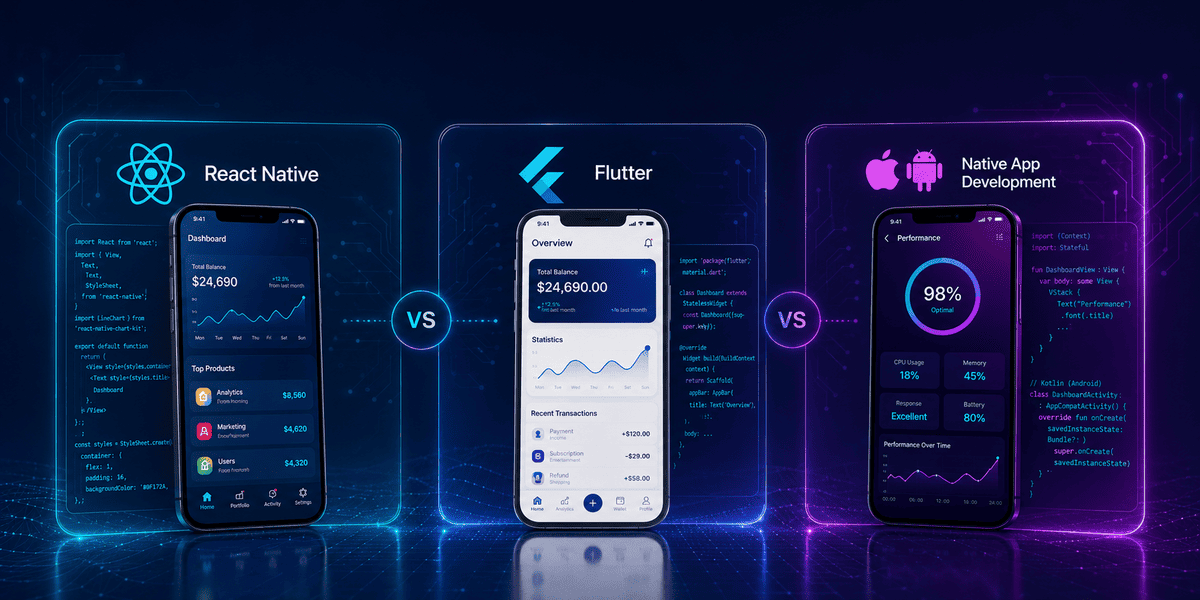


Choosing between React Native, Flutter, and native app development is one of the first major decisions when building a mobile app in 2026.
The short answer is simple.
React Native is often a strong choice for businesses that want iOS and Android apps from one codebase and already use JavaScript or React.
Flutter is a strong option when you need a highly custom user interface and want to target several platforms with one codebase.
Native app development is often the best choice when maximum performance, deep device access, platform-specific features, or long-term platform control are the main goals.
There is no single winner for every project.
Your best choice depends on your budget, timeline, app complexity, performance needs, team skills, and long-term product goals.
This guide compares React Native vs Flutter vs native development across the areas that matter most to business owners in 2026.
React Native vs Flutter vs Native: Quick Comparison

For many startups and businesses, React Native or Flutter can reduce development effort because one team can build for both Android and iOS.
Native development usually requires separate platform work but gives developers the deepest control over each operating system.
What Is React Native?
React Native is an open-source framework for building mobile applications using JavaScript and React.
It allows developers to share much of their application code between Android and iOS while still working with native platform features.
React Native was created by Meta.
One of its biggest advantages is its connection with the large JavaScript and React developer ecosystem.
In 2026, React Native is very different from its early versions.
Its new architecture is now the standard direction for the framework. React Native 0.76 enabled the new architecture by default, and later releases continued moving away from the old architecture. React Native 0.84 also made Hermes V1 the default JavaScript engine. These changes are designed to improve performance and the way JavaScript communicates with native platform code.
Businesses planning a cross-platform application can learn more about Infinijith's React Native app development services.
What Is Flutter?
Flutter is Google's open-source framework for building applications from a single Dart codebase.
Developers can use Flutter for:
- Android
- iOS
- Web
- Windows
- macOS
- Linux
Flutter uses its own rendering system to give developers strong control over how the app looks.
According to Flutter's official documentation, Flutter applications are natively compiled and can target several platforms from one codebase.
Flutter continues to receive major platform and performance improvements in 2026.
Google's 2026 Flutter roadmap places strong focus on its Impeller rendering engine, WebAssembly for web apps, and deeper support for new Android and iOS releases.
This makes Flutter an important option for businesses that need strong design control across several platforms.
What Is Native App Development?
Native app development means building an application specifically for one operating system using that platform's main tools and technologies.
For iOS, developers commonly use:
- Swift
- SwiftUI
- Xcode
For Android, developers commonly use:
- Kotlin
- Jetpack Compose
- Android Studio
A company that wants both an Android and an iOS native app will normally maintain separate platform code.
Apple describes SwiftUI as its modern framework for creating apps across Apple platforms using Swift.
Google also describes Jetpack Compose as Android's recommended modern toolkit for building native interfaces. In 2026, Google states that Android development is now Compose-first for new UI tools and guidance.
Native development gives developers the closest access to each operating system.
That can become important for apps with complex hardware, performance, security, or platform needs.
React Native vs Flutter vs Native: Which Is Best in 2026?
There is no universal winner.
A better way to compare these technologies is to look at the type of product you want to build.
Choose React Native when:
- You want Android and iOS apps from one main codebase.
- Your company already uses React or JavaScript.
- You want faster cross-platform development.
- Your app is a SaaS, marketplace, service, eCommerce, or business application.
- You want a large JavaScript ecosystem.
Choose Flutter when:
- You need a highly custom user interface.
- Design consistency across platforms is important.
- You may expand to web or desktop.
- Your development team is comfortable with Dart.
- Your application depends on animations and custom UI.
Choose Native when:
- Maximum platform performance is important.
- The app depends heavily on device hardware.
- You need the latest iOS or Android APIs quickly.
- Your application has advanced platform-specific features.
- You are building a long-term product focused strongly on one platform.
React Native vs Flutter vs Native Performance
Performance is often the first question businesses ask.
Native Performance
Native development usually offers the highest level of direct platform performance.
There is no cross-platform framework between your business logic and many operating system features.
Native developers also get direct access to platform tools and APIs.
This can make native development useful for:
- Advanced graphics
- Video processing
- AR and VR
- Gaming
- Complex Bluetooth features
- Heavy background processing
- Advanced camera applications
This does not mean every native application will automatically be faster.
App architecture and code quality still matter.
React Native Performance
React Native performance has improved greatly.
Its new architecture replaced the older bridge-based communication model with a newer system built around JSI.
This allows JavaScript and native code to communicate more directly.
React Native says the new architecture improves native and JavaScript interaction and supports demanding use cases such as real-time camera processing.
For normal business applications, React Native performance can be more than enough.
Examples include:
- eCommerce apps
- CRM apps
- Booking platforms
- Customer service apps
- SaaS mobile apps
- Employee apps
- Fintech interfaces
Some advanced features may still need native modules.
React Native supports connecting JavaScript code with Swift, Kotlin, Objective-C, Java, and C++ when required.
Flutter Performance
Flutter is also designed for strong mobile performance.
Flutter compiles its application code for the target platform and controls much of its own UI rendering.
Flutter's official performance documentation states that Flutter apps are generally performant by default when common rendering problems are avoided.
The Impeller rendering engine is also a major part of Flutter's performance strategy.
Google's 2026 roadmap says it is completing the move to Impeller on Android 10 and above.
Performance Winner
For maximum control:
Native wins.
For most normal business applications:
React Native and Flutter can both deliver strong performance.
The difference may not be noticeable to most users when the app is designed and built correctly.
React Native vs Flutter vs Native Development Speed
Development time affects both cost and time to market.
React Native Development Speed
React Native allows teams to reuse much of the same code for Android and iOS.
This can reduce repeated development work.
It also supports fast development because developers can use JavaScript or TypeScript.
React developers may find the move to React Native easier than learning a completely new language.
React Native can therefore be a strong option when speed is important.
Flutter Development Speed
Flutter also allows teams to build several platforms from one main codebase.
Its Hot Reload feature lets developers see many code changes quickly without restarting the whole application.
Flutter provides a large set of built-in widgets.
This can speed up UI development.
For businesses that need the same custom design across Android and iOS, Flutter can be very productive.
Native Development Speed
Native development can take more work when you need both Android and iOS.
You may need:
- Swift developers for iOS
- Kotlin developers for Android
- Separate testing
- Separate platform fixes
- Platform-specific releases
Modern tools such as SwiftUI and Jetpack Compose have made native UI development faster than before.
Apple's SwiftUI uses a declarative approach and supports live previews in Xcode.
Google also says Jetpack Compose helps developers build Android interfaces with less code and faster iteration.
Still, two native platforms normally mean more total development effort than one shared cross-platform codebase.
Development Speed Winner
For most two-platform business apps:
React Native and Flutter usually have the advantage.
React Native vs Flutter vs Native Development Cost
Cost is another major business concern.
There is no fixed price based only on the framework.
Your cost also depends on:
- Number of screens
- Backend complexity
- APIs
- Payment systems
- AI features
- Third-party integrations
- Security
- UI design
- Testing
- App maintenance
However, the development approach can affect the total budget.
React Native Cost
React Native can reduce cost when Android and iOS share much of the same code.
One cross-platform team may handle most of the application.
It can be a cost-effective option for:
- Startups
- MVPs
- SaaS companies
- Service businesses
- Marketplaces
- Internal business apps
Flutter Cost
Flutter offers a similar cost advantage.
A shared Dart codebase can support both Android and iOS.
It can also make sense when you plan to expand the product to other platforms later.
Native Development Cost
Native development can cost more when separate iOS and Android teams are required.
You may be paying for:
- Two codebases
- Two development workflows
- More testing
- More platform-specific maintenance
However, the higher initial cost can still make business sense if your product needs native-level control.
If you are planning your mobile budget, read our complete mobile app development cost guide to understand the main factors that affect pricing.
React Native vs Flutter vs Native UI and Design
The user interface is another area where the three approaches differ.
React Native UI
React Native works closely with native platform components.
This can help applications feel familiar on both Android and iOS.
Developers can also create custom UI when needed.
React Native is a good option for companies that want:
- Clean business apps
- Familiar mobile patterns
- Platform-specific behaviour
- Shared development
Flutter UI
Flutter gives developers very high control over visual design.
It uses its own widget system and rendering approach.
This makes it easier to create a similar visual experience across several devices.
Flutter may be a strong choice for:
- Brand-heavy applications
- Highly custom UI
- Rich animations
- Interactive experiences
- Apps that need the same design across platforms
Native UI
Native development gives developers full access to the platform's own UI tools.
On iOS, SwiftUI can work with existing UIKit components.
On Android, Jetpack Compose provides direct access to Android design features and platform APIs.
Native development is often ideal if you want your application to closely follow every platform convention.
UI Winner
For highly custom and consistent designs:
Flutter has a strong advantage.
For platform-specific experiences:
Native is strongest.
For a balance of shared code and native behaviour:
React Native is often a good middle ground.
React Native vs Flutter vs Native for Device Features
Some apps depend on advanced device functions.
These can include:
- Camera
- Bluetooth
- GPS
- NFC
- Biometrics
- Sensors
- Background services
- Health data
- Wearable devices
Native
Native development provides direct access to operating system APIs.
This makes it the safest choice when your product depends heavily on new or advanced device functions.
React Native
React Native supports many device features through libraries and native modules.
If a feature is not available through an existing package, developers can create native integrations.
Flutter
Flutter also has a large plugin ecosystem.
When a plugin is not available, Flutter allows developers to write platform-specific native code. Flutter's documentation directly supports this approach for platform functions that need native implementation.
Device Integration Winner
For the deepest device access:
Native wins.
For most normal business features:
React Native and Flutter are usually enough.
React Native vs Flutter vs Native for Maintenance
Businesses should not think only about launch.
Your app may need to operate for five years or more.
React Native Maintenance
A shared codebase can make many updates easier.
One feature update may cover both Android and iOS.
However, major operating system updates and third-party package changes still need careful testing.
Flutter Maintenance
Flutter also provides the benefit of a shared codebase.
Its centralised widget system can make consistent UI updates easier.
However, teams must continue updating Flutter, Dart, packages, Android builds, and iOS builds.
Native Maintenance
Native apps have separate codebases.
This can increase maintenance work.
However, teams also get direct support from Apple's and Google's development tools.
New platform features may be easier to adopt without waiting for a cross-platform library.
Maintenance Winner
For shared feature maintenance:
React Native and Flutter often cost less.
For direct long-term platform control:
Native has an advantage.
React Native vs Flutter vs Native for App Size
App size varies based on the code, assets, libraries, and features you include.
Native applications can often have less framework overhead because they use platform tools directly.
Flutter applications include parts of the Flutter engine.
React Native applications also include framework and JavaScript runtime components.
However, app size should rarely be the only reason for choosing your technology.
A 5 MB difference matters far less than:
- User experience
- Product quality
- Development speed
- Stability
- Business results
React Native vs Flutter vs Native for Existing Development Teams
Your current team should influence the decision.
Choose React Native if your team knows:
- JavaScript
- TypeScript
- React
- Node.js
The learning curve may be easier.
Choose Flutter if your team:
- Is open to learning Dart
- Has strong UI experience
- Wants one multi-platform framework
Choose Native if your team already has:
- Swift developers
- Kotlin developers
- Strong Android or iOS knowledge
Do not ignore your existing skills.
Changing the whole technology stack can increase both cost and risk.
React Native vs Flutter vs Native for AI-Powered Mobile Apps
AI is becoming an important part of mobile applications.
Businesses are building:
- AI assistants
- AI chat apps
- Recommendation systems
- Image analysis tools
- Voice applications
- AI agents
- Predictive apps
All three approaches can support AI.
React Native for AI Apps
React Native works well when most AI processing happens through:
- Cloud APIs
- Backend services
- LLM APIs
- RAG systems
The mobile app can act as the user interface while AI work happens in the backend.
Flutter for AI Apps
Flutter can follow the same model.
It can connect with AI APIs, backend services, and cloud platforms.
Flutter's documentation now also includes resources for building applications with AI tools.
Native for AI Apps
Native may have an advantage when AI runs heavily on the device.
Examples include:
- Advanced camera AI
- Real-time vision processing
- On-device machine learning
- Hardware-specific AI
- Deep Apple or Android AI APIs
If AI is central to your product, explore Infinijith's AI-powered mobile app development services.
React Native vs Flutter vs Native for Startups
For many startups, the main goals are:
- Launch fast
- Control development cost
- Test the market
- Support Android and iOS
- Make changes quickly
React Native and Flutter can both work well for these goals.
React Native may be especially useful if the startup already has JavaScript developers.
Flutter may make sense when custom visual design is a major part of the product.
Native development may be harder to justify for an early MVP unless platform-specific performance is a core requirement.
Best Choice for Most Startups
React Native or Flutter.
React Native vs Flutter vs Native for Enterprise Apps
Enterprise requirements can be different.
Large organisations may need:
- Strong security
- Device management
- ERP integration
- CRM integration
- SSO
- Offline support
- Complex APIs
- Long-term maintenance
All three technologies can support enterprise apps.
The decision depends on the system.
React Native can work well for business applications that need to move fast across Android and iOS.
Flutter can work well when one consistent interface is required across many devices.
Native development may be best when deep operating system control or strict platform features are required.
React Native vs Flutter vs Native for eCommerce and Marketplace Apps
eCommerce and marketplace applications often need:
- Product listings
- Search
- Payments
- User accounts
- Notifications
- Chat
- Location
- Order tracking
These features usually do not require deep platform-specific code.
React Native and Flutter can therefore be strong choices.
The bigger business questions are often:
- How fast can we launch?
- How easy will updates be?
- How much will development cost?
- Can we scale the backend?
For many eCommerce products, cross-platform development provides a practical balance.
React Native vs Flutter vs Native for Fintech and Healthcare
Fintech and healthcare applications require extra care.
They may handle:
- Financial data
- Health information
- Identity
- Payments
- Biometrics
- Secure storage
- Device security
Native development may provide more direct access to some platform security features.
However, React Native and Flutter can also support secure applications when they are designed correctly.
The important factor is not only the framework.
Security also depends on:
- Backend architecture
- Encryption
- API security
- Authentication
- Data storage
- Developer practices
- Testing
Never choose a mobile framework as your only security decision.
Can You Mix React Native or Flutter With Native Code?
Yes.
This is an important point.
Choosing cross-platform development does not mean you can never use native code.
React Native allows developers to create native modules and native components when platform-specific functionality is needed.
Flutter also allows developers to integrate platform-specific code and create plugins when required.
This means companies can use:
Shared cross-platform code + native code for special features.
For many real-world projects, this hybrid approach provides a good balance.
React Native vs Flutter vs Native: Decision Table

How to Choose the Right Mobile App Technology
Use these steps before making your decision.
Step 1: Define Your Platforms
Ask:
Do you need Android?
iOS?
Both?
Web or desktop later?
If you need many platforms, Flutter may become more attractive.
Step 2: Define Your Performance Needs
Ask whether your application needs:
- Complex animation
- Real-time video
- AR
- Heavy graphics
- Advanced background tasks
If yes, native development deserves serious consideration.
Step 3: Review Your Team
A React web team may move faster with React Native.
An experienced Swift or Kotlin team may prefer native development.
Step 4: Define Your Budget
Cross-platform development can reduce repeated work.
For businesses with a limited MVP budget, this can be important.
Step 5: Review Device Integrations
List every mobile feature you need.
For example:
- Bluetooth
- Camera
- NFC
- GPS
- Biometrics
- Sensors
Then check how easily each technology can support them.
Step 6: Think Beyond the First Release
Your technology should support future plans.
Ask:
- Will the app become more complex?
- Will we need new platforms?
- Will AI features be added?
- Will the user base grow?
- Will we need deep hardware access later?
Do not choose only for version one.
Common Mistakes When Choosing a Mobile App Framework
Choosing Only Based on Cost
The cheapest development option is not always the lowest-cost option over five years.
Think about maintenance too.
Choosing Based on Developer Trends
A popular framework is not automatically right for your product.
Choose based on your requirements.
Ignoring Future Features
Your MVP may be simple today.
Future plans may require advanced integrations.
Plan for them early.
Assuming Cross-Platform Means Zero Native Code
Many complex apps still need some native work.
This is normal.
Assuming Native Is Always Faster
Poor native code can perform badly.
Good architecture matters more than the technology name alone.
Frequently Asked Questions
Which is better in 2026: React Native or Flutter?
Neither is better for every project. React Native is often a good choice for teams that already use JavaScript or React. Flutter is strong for custom UI and multi-platform consistency.
Is React Native still good in 2026?
Yes. React Native continues to receive major updates. Its new architecture is now central to the framework, and recent releases have improved its runtime and native integration.
Is Flutter still worth using in 2026?
Yes. Flutter remains an actively developed multi-platform framework. Google's 2026 roadmap includes continued work on Impeller, WebAssembly, platform support, and performance.
Is native app development better than Flutter?
Native development gives more direct platform access and control. Flutter can reduce development work when you need to support several platforms. The better choice depends on your requirements.
Is native development better than React Native?
Native can be better for apps that need maximum performance or deep operating system integration. React Native can be better when faster Android and iOS development is more important.
Which is faster: React Native or Flutter?
Both can deliver strong performance for most business applications. Actual performance depends on architecture, UI complexity, native integrations, and developer skill.
Which is cheaper: Flutter or React Native?
Development costs are often similar. The final cost depends more on app features, backend complexity, integrations, and team rates than on the framework alone.
Which technology is best for an MVP?
React Native and Flutter are often strong choices because they allow businesses to build Android and iOS apps from one main codebase.
Which is best for a startup?
React Native or Flutter often makes sense for startups that need faster market entry. The team's existing skills should also guide the decision.
Which framework is best for enterprise apps?
React Native, Flutter, and native development can all work for enterprise applications. The right choice depends on security, integrations, performance, device access, and maintenance needs.
Can React Native apps use native code?
Yes. React Native supports native modules and components for platform-specific functionality.
Can Flutter use native Android and iOS code?
Yes. Flutter supports platform-specific integrations and custom plugins.
Which is best for AI mobile app development?
React Native and Flutter work well when AI runs mainly through cloud or backend APIs. Native development may be stronger when the application requires heavy on-device AI or deep hardware integration.
React Native vs Flutter vs Native: Final Verdict
So, which technology should you choose in 2026?
There is no single answer.
For many business applications:
React Native provides a strong balance of speed, shared code, native integration, and developer availability.
For products where design consistency and custom interfaces matter most:
Flutter is a strong choice.
For products that require maximum platform control, deep hardware features, or advanced performance:
Native development remains the strongest option.
The right technology should support your business goals—not force your business to fit the technology.
Before choosing, define:
- Your target users
- Required platforms
- Core features
- Performance needs
- Integrations
- Budget
- Timeline
- Future roadmap
Then choose the technology that fits those needs.
Build the Right Mobile App With Infinijith
Choosing between React Native, Flutter, and native development can be difficult when you are planning a new product.
Infinijith helps businesses choose the right mobile technology based on the actual requirements of the project.
Our mobile application development services cover Android, iOS, cross-platform apps, backend development, APIs, integrations, testing, and post-launch support.
If React Native fits your product, explore our React Native app development services.
If your application includes AI features, you can also explore our AI-powered mobile app development services.
Before starting development, you may also want to review our mobile app development cost guide to understand the factors that affect your budget.
Planning a mobile app in 2026? Talk to Infinijith about your app idea, target platforms, features, budget, and long-term product goals.