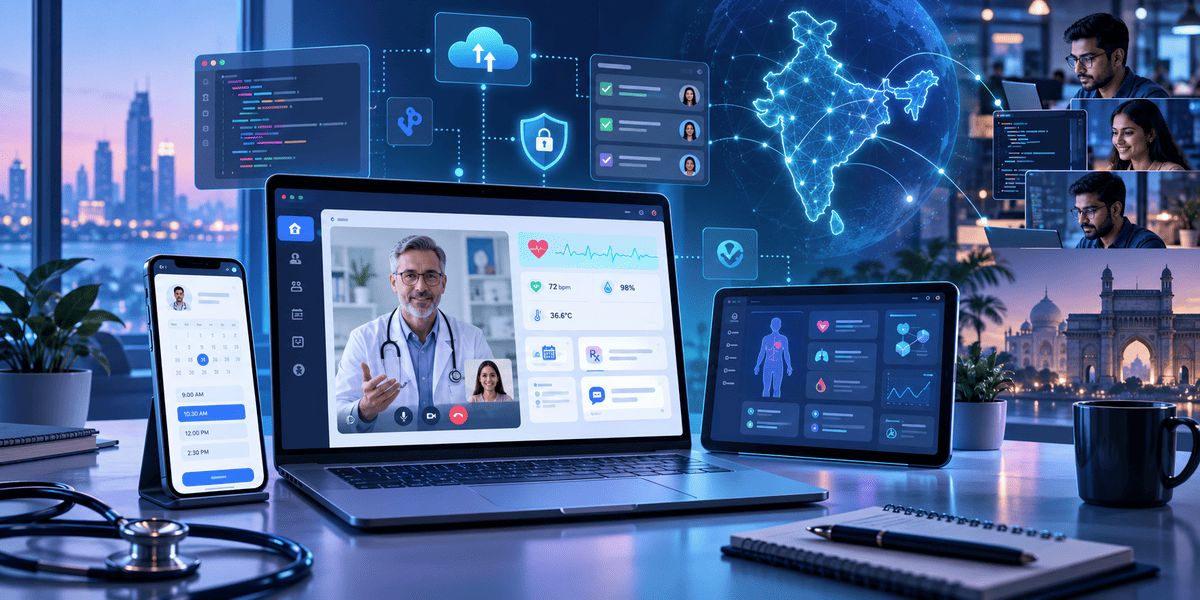


Ask someone to describe a telemedicine app, and the answer often sounds simple.
A patient books a doctor. They join a video call. The doctor adds notes. The visit ends.
That may be what the patient sees.
Behind that screen, however, several things need to work at the same time.
The app needs to know who the patient is. It needs to show the right doctor at the right time. The video session needs to work on a weak mobile network. Patient information must only be visible to the people who should see it. Payments, reminders, records, and third-party systems may all need to connect.
This is why hiring developers for a telemedicine product is different from hiring someone to build a standard business app.
There is another question many healthcare businesses face.
Should we build the team locally or hire offshore developers in India?
Offshore development can work very well for telemedicine. It can give you access to mobile, backend, QA, cloud, and design skills without hiring every role internally.
But it only works when the team is chosen for the right reasons.
The cheapest hourly rate is rarely the best place to start.
A better question is:
Can this team understand the mHealthcare workflow, protect sensitive data, communicate clearly, and leave us with software we can maintain after launch?
That is what this guide is about.
What Is Telemedicine App Development?
Telemedicine app development is the process of building software that allows patients and healthcare professionals to connect remotely.
Depending on the product, that may happen through a mobile app, web app, or both.
A telemedicine platform may support:
- Appointment booking
- Doctor search
- Video consultations
- Audio consultations
- Secure messaging
- Online payments
- Patient records
- Consultation notes
- Prescription workflows
- Follow-up reminders
- Remote monitoring
- Healthcare system integrations
The mistake is assuming every telemedicine app needs all of them.
It does not.
A specialist clinic may only need booking, reminders, video consultation, payments, and basic follow-up.
A hospital network may need several user roles, deeper integrations, complex access rules, reporting, and connections with existing healthcare systems.
The right application starts with the healthcare workflow, not a feature checklist.
Before You Hire Developers, Map One Patient Visit
This is one of the most useful things a healthcare business can do before requesting development quotes.
Take one normal patient journey and write it down.
For example:
Find doctor → View available slot → Book appointment → Pay → Receive reminder → Join consultation → Get follow-up
Then ask what happens at each step.
What if payment fails?
What if the doctor cancels?
What if the patient joins ten minutes late?
What if the internet drops during the call?
What if the doctor needs to review an earlier consultation?
What if the patient needs another appointment?
These questions may sound small, but they shape the application.
They also make offshore development much easier.
A developer can estimate and design a clear workflow.
“Build a modern telemedicine platform” gives them almost nothing useful to work with.
Why Hire Offshore Developers in India?
Cost is part of the answer, but it should not be the whole answer.
A telemedicine product can require several skills at once.
You may need a mobile developer for the patient app, a backend developer for APIs and data, a designer for the user experience, a QA engineer for testing, and someone who understands cloud deployment.
Recruiting all of those people in-house takes time.
With an offshore team, a business can bring several roles together under one delivery model.
That can be useful when:
- You need to launch an MVP
- Your internal team is too small
- You need skills that are missing in-house
- You want a dedicated development team
- You need support across mobile, backend, QA, and cloud
- You want to extend an existing product team
India has a large software engineering market, but that does not mean every company is the right fit.
Country is not the qualification.
The actual developers, delivery process, security practices, and communication model are what matter.
What Should a Good Telemedicine Development Team Understand?
A team does not need to know every healthcare system in the world.
But it should understand that healthcare software has different risks from a normal consumer app.
There are several areas I would check.
Mobile Development That Works Outside the Office
Telemedicine is often used on phones.
That sounds obvious, but it changes how the product should be tested.
Your patient may not be sitting in an office with fast Wi-Fi and a new device.
They may be using an older Android phone with weak mobile data.
A doctor may be moving between rooms.
Notifications may arrive while the app is closed.
The developers should think about:
- Android and iOS support
- Weak connections
- Camera and microphone permissions
- Call reconnection
- Battery use
- Push notifications
- Older devices
- Accessibility
React Native or Flutter can make sense when you want a shared mobile codebase.
Native Swift or Kotlin may make more sense when the app needs deep device-level features.
There is no automatic winner.
The team should be able to explain why its choice suits your product.
A Backend That Protects the Workflow
Patients spend most of their time looking at the frontend.
A lot of the important work happens behind it.
The backend may decide:
- Who can sign in
- Which patient a doctor can view
- Whether an appointment is valid
- Who can change a record
- Whether a payment succeeded
- Which notification should be sent
- Which external system can receive information
This is where a weak technical design becomes risky.
A polished patient app is not enough if the backend has poor permission checks or unclear business rules.
When interviewing developers, ask them to explain the backend in plain language.
If the answer is only a list of frameworks, keep asking.
Video Calls Need a Failure Plan
A telemedicine demo usually happens on a good connection.
Real life does not.
Suppose the consultation starts at 3:00 PM.
At 3:07, the patient's connection disappears.
What happens next?
Does the app keep trying forever?
Does the doctor know the patient lost connection?
Can the patient rejoin the same visit?
Do they have to book again?
Can the consultation continue through audio?
These are better questions than simply asking:
“Can you integrate video calling?”
Many developers can integrate video.
The harder part is designing what happens when video stops working.
Patient Data Needs Clear Boundaries
A healthcare app should not treat every logged-in user the same.
Patients, doctors, administrators, support staff, and other users may need very different levels of access.
A patient may be able to see their own appointments.
A doctor may need access to assigned patients.
A support employee may need enough information to solve an appointment problem without seeing clinical notes.
An administrator may need reporting but not unrestricted access to every piece of patient data.
These boundaries should be designed before development gets too far.
Fixing access control after the whole product has been built can become painful.
Security Is Not a Feature You Add Before Launch
One of the questions I would ask an offshore team very early is:
“Show me where sensitive data moves through this application.”
Where does it enter?
Where is it stored?
Which services receive it?
Who can access it?
How long is it kept?
What gets written to logs?
Those answers are more useful than hearing that a company “follows best security practices".
For telemedicine products, security can include:
- Strong authentication
- Role-based access
- Encryption
- Secure APIs
- Safe secret management
- Session controls
- Audit logging
- Backup protection
- Cloud access controls
- Data retention rules
The legal requirements depend on the market you serve.
For products processing personal data in India, the Digital Personal Data Protection Act and the Digital Personal Data Protection Rules, 2025, should be reviewed as part of the compliance process. The 2025 Rules have phased commencement dates rather than all provisions taking effect at once.
India's Telemedicine Practice Guidelines also address areas such as patient and practitioner identification, consent, communication methods, and remote consultations by registered medical practitioners.
If your product is used by U.S. healthcare providers or health plans that fall under HIPAA, the technology and data handling may also need to meet HIPAA requirements. HHS specifically points to secure communications and health-data storage for covered telehealth services.
A software vendor should help translate your requirements into technical controls.
It should not replace legal or clinical advice.
How to Hire Offshore Telemedicine Developers in India
You do not need a complicated vendor selection process.
You do need a disciplined one.
Here is how I would approach it.
1. Give the Team a Workflow, Not Just a Feature List
Start with three things:
Who uses the app?
What are they trying to complete?
What must happen if something goes wrong?
For a patient, the main journey might be:
Register → Find doctor → Book → Pay → Consult → Follow up
For a doctor:
Set availability → Review schedule → Open patient context → Consult → Add notes → Follow up
For an administrator:
Manage doctors → Monitor appointments → Handle issues → Review platform activity
Once these flows are clear, features become easier to plan.
2. Decide Whether You Need One Developer or a Product Team
If your company already has designers, QA, architecture, and project leadership, one offshore developer may be enough.
If you are building the product from the beginning, one developer usually will not cover everything.
A small telemedicine team may include:
- Mobile developer
- Backend developer
- UI/UX designer
- QA engineer
- Technical lead
You may not need every role full-time.
The point is to understand who owns each part of the product.
3. Ask for Relevant Work, Not a Huge Portfolio
A portfolio with fifty apps tells you very little.
Ask for work that is close to your problem.
It does not have to be an identical telemedicine app.
Useful experience may include:
- Healthcare apps
- Secure communication platforms
- Appointment systems
- Video products
- Payment systems
- Role-based platforms
- Apps that handle sensitive data
Then ask what went wrong during those projects.
This is a useful test.
Experienced teams normally have stories about difficult integrations, failed assumptions, performance issues, or requirements that changed.
A team that claims every project went perfectly may simply be giving you a sales answer.
4. Interview the People Who Will Write the Code
Do not stop at the sales meeting.
Ask to speak with the developers who may actually join your project.
Give them a small real-world problem.
For example:
“The doctor has joined the visit, but the patient cannot connect. How would you design the experience?”
Or:
“A support employee needs to reschedule an appointment but should not see the patient's clinical notes. How would you handle access?”
You are not looking for one perfect answer.
You are looking at how the developer thinks.
Do they ask questions?
Do they consider the patient?
Do they think about errors?
Do they understand permissions?
That tells you more than a list of certifications.
5. Ask to See the Testing Plan
A telemedicine product needs more than “we test before release".
Ask what will actually be tested.
I would expect to hear about:
- Login failures
- User permissions
- Appointment conflicts
- Payment errors
- Video reconnects
- Slow networks
- Notification delivery
- API failures
- Different screen sizes
- Older devices
- Browser differences
- Accessibility
- Data access
A useful test plan is tied to real user journeys.
It is not just a long spreadsheet of buttons.
6. Use a Small Paid Pilot When You Are Unsure
A paid pilot can be much more useful than another presentation.
Give the team a real piece of the product.
For example:
- Appointment booking
- Doctor availability
- Secure patient login
- A simple video consultation flow
- The patient dashboard
Then look at the result.
Was the code clear?
Did they ask good questions?
Was communication easy?
Were edge cases considered?
Did they test the work?
Could another developer understand what they built?
A two-week pilot can reveal things that a sales proposal cannot.
7. Agree on Communication Before Signing
Offshore teams fail more often from unclear communication than from time-zone differences.
Decide the basics before development begins.
How much working time will overlap?
Who attends the main meeting?
Where will requirements live?
Who can approve a change?
How often will you see a demo?
How are blockers raised?
What happens during an urgent production issue?
A good offshore setup should feel like part of your product team.
Not a black box where requirements disappear for two weeks and code comes back.
8. Keep Ownership of Your Product Clear
This is easy to overlook at the start.
Make sure the contract explains:
- Source-code ownership
- Repository access
- Intellectual property
- Design files
- Cloud accounts
- Third-party services
- Documentation
- Confidentiality
- Developer access when the project ends
Your business should not discover after launch that the only production password belongs to the vendor.
Keep critical accounts under company control.
What Should the First Telemedicine MVP Include?
There is no perfect list.
For many products, I would start much smaller than people expect.
A useful first release could include:
Patient
- Registration
- Doctor search
- Appointment booking
- Video consultation
- Payment
- Notifications
- Visit history
Doctor
- Profile
- Availability
- Appointment schedule
- Patient context
- Video consultation
- Visit notes
- Follow-up
Administrator
- Doctor management
- Patient support
- Appointment oversight
- Payment status
- Basic reporting
- User access management
That is already a meaningful product.
You can add advanced reporting, wearables, AI, deep integrations, and other features once real usage tells you they are needed.
What Technology Stack Should You Use?
There is no telemedicine stack that is automatically better than every other option.
A project may use:
Mobile: React Native, Flutter, Swift, or Kotlin
Web: React, Angular, or Next.js
Backend: Node.js, Java, .NET, or Python
Database: PostgreSQL, MySQL, MongoDB, or another suitable database
Cloud: AWS, Azure, or Google Cloud
Video: WebRTC or a managed communication provider
The framework is rarely the hardest decision.
Maintenance matters more.
Ask:
Can our team hire people who know this stack?
Can we test it well?
Can we update it?
Will it support the integrations we need?
Does it suit our data and security model?
Those questions last longer than technology trends.
How Much Does Telemedicine App Development Cost?
A useful answer starts with:
It depends on what you are actually building.
That may sound less attractive than a fixed number, but it is more honest.
The main cost drivers usually include:
- iOS, Android, web, or all three
- Number of user roles
- Appointment complexity
- Video features
- Payment flows
- Backend requirements
- Healthcare integrations
- Security requirements
- Design work
- QA effort
- Team size
- Support after launch
A basic clinic MVP and a multi-provider healthcare platform should not have similar estimates.
Be careful when a vendor gives you a final quote after one short call.
A useful estimate should show assumptions.
For example:
What platforms are included?
What integrations are included?
Who supplies the design?
Is QA included?
Does the estimate include deployment?
What happens if requirements change?
The number matters.
What is behind the number matters more.
How Long Does It Take?
The same rule applies to timelines.
A focused MVP can move quickly.
A product with several third-party integrations, complex workflows, regulatory reviews, and multiple apps will take longer.
Instead of asking only:
“How many months will this take?”
Ask:
“What can I review after the first four weeks?”
A good team should be able to break the project into working stages.
That makes progress easier to see and problems easier to catch.
Should You Hire Freelancers or an Offshore Development Company?
For a small piece of work, a strong freelancer can be a good option.
A full telemedicine product is different.
You may need design, mobile app development, backend engineering, QA, cloud work, and ongoing maintenance.
Managing five separate freelancers means your business becomes responsible for coordinating those five people.
An offshore development company can make that easier by providing a team structure.
But a company is not automatically better.
Evaluate the people who will work on the project.
That is still the most important step.
Can You Add AI to a Telemedicine App?
Yes, but start with a problem.
Do not start with:
“We need AI in the app.”
A better question is:
“Which part of the healthcare workflow is taking too much time?”
AI may be useful for:
- Appointment support
- Document summarisation
- Search
- Administrative workflows
- Drafting notes
- Patient support
- Organising information
But healthcare raises the cost of being wrong.
An AI-generated appointment suggestion and an AI-generated medical decision do not carry the same risk.
For higher-impact use cases, clinical review, safety testing, privacy review, and regulatory requirements become much more important.
Common Offshore Hiring Mistakes We Would Avoid
Choosing the Cheapest Quote
Low hourly rates do not help if the application needs to be rebuilt.
Compare the complete cost of getting to a stable product.
Starting With 50 Features
A large scope makes estimates less reliable and delays user feedback.
Build the core healthcare journey first.
Treating Security as a Final Checklist
Security choices affect architecture.
Make them early.
Never Meeting the Developers
You are hiring a team, not a proposal document.
Talk to them.
Testing Only on Good Wi-Fi
Real patients will use real networks.
Test accordingly.
Giving the Vendor Every Account
Keep ownership of repositories, cloud accounts, domains, and critical services clear.
Forgetting About the Day After Launch
Someone needs to monitor errors, update dependencies, fix bugs, and respond to new requirements.
Include that in the plan.
Why Consider Infinijith for Telemedicine App Development?
Building a telemedicine product usually means coordinating several parts of software development.
Mobile apps need to work with backend services.
Backend services need to connect with databases and other platforms.
The whole product needs testing, deployment, monitoring, and ongoing improvement.
At Infinijith, we work across mobile, web, backend, full-stack, cloud, and dedicated development services.
For a telemedicine project, the starting point should be a clear discussion about the healthcare workflow.
Who are the users?
What does the patient need to complete?
What does the doctor need during the consultation?
What information is sensitive?
Which systems must connect?
What needs to be in the first release?
Once those questions are answered, the development plan becomes much clearer.
Frequently Asked Questions
What is telemedicine app development?
Telemedicine app development is the process of creating mobile or web software that lets patients and healthcare professionals interact remotely. Common functions include booking, video visits, messaging, payments, patient information, and follow-up workflows.
Why hire offshore developers in India for telemedicine development?
An offshore team in India can give a healthcare business access to mobile, backend, QA, cloud, and design skills without hiring every role internally. The team should still be evaluated for healthcare knowledge, security, communication, and code quality.
What should I ask a telemedicine app development company before hiring?
Ask who will work on the product, how patient data is protected, how video-call failures are handled, how code is tested, who owns the source code, how communication works, and what happens after launch.
How do I choose the right offshore development team?
Review relevant projects, interview the actual developers, give them a real product scenario, check their testing process, and consider a small paid pilot before making a long-term commitment.
Is telemedicine app development secure?
It can be. Security depends on the architecture and development process. Authentication, role-based access, encryption, secure APIs, data handling, logging, cloud permissions, and ongoing updates should be planned from the start.
What features should a telemedicine MVP include?
A focused MVP may include patient registration, doctor profiles, appointment booking, video visits, payments, notifications, basic doctor notes, and an admin area. The exact scope should follow the healthcare workflow.
How much does a telemedicine app cost to build?
There is no single price. Cost depends on platforms, features, video needs, integrations, security requirements, design, testing, team size, and post-launch support.
How long does telemedicine app development take?
The timeline depends on scope and complexity. A focused MVP can be delivered faster than a multi-platform healthcare system with several integrations. Ask the team to divide the work into milestones rather than giving only one final delivery date.
Can AI be used in a telemedicine app?
Yes. AI may help with scheduling, search, summarisation, administrative work, and documentation. Higher-impact clinical uses need much stronger safety, privacy, medical, and regulatory review.
Can an offshore team support the app after launch?
Yes. Offshore development teams can provide ongoing support for bugs, monitoring, security updates, mobile OS changes, performance improvements, and new features. The support terms should be agreed before launch.
Ready to Build a Telemedicine App?
A good telemedicine product is not defined by how many features it has.
It is defined by whether a patient can get through the care journey without confusion, whether a doctor can do their work without extra friction, and whether the business can operate the platform safely.
If you are planning a telemedicine product, start with one clear patient journey.
Then build the team around that problem.
Talk to the Infinijith offshore development team in India to discuss your telemedicine app, technical requirements, and first release.