

Choosing a database sounds simple when a project begins.
You need a place to store users, products, orders, payments, and other app data. So you pick PostgreSQL or MySQL and start building.
The real questions often come later.
What happens when your data grows?
What if your queries become complex?
Which database is better for JSON?
Which one is easier for your team to manage?
And which database will still work well when your product becomes much larger?
PostgreSQL and MySQL are two of the most popular relational databases. Both have been used for years. Both can power small websites, SaaS products, business apps, and large systems.
So this comparison is not about saying one database is good and the other is bad.
It is about finding the right fit for your project.
Let’s compare PostgreSQL and MySQL from a real developer point of view.
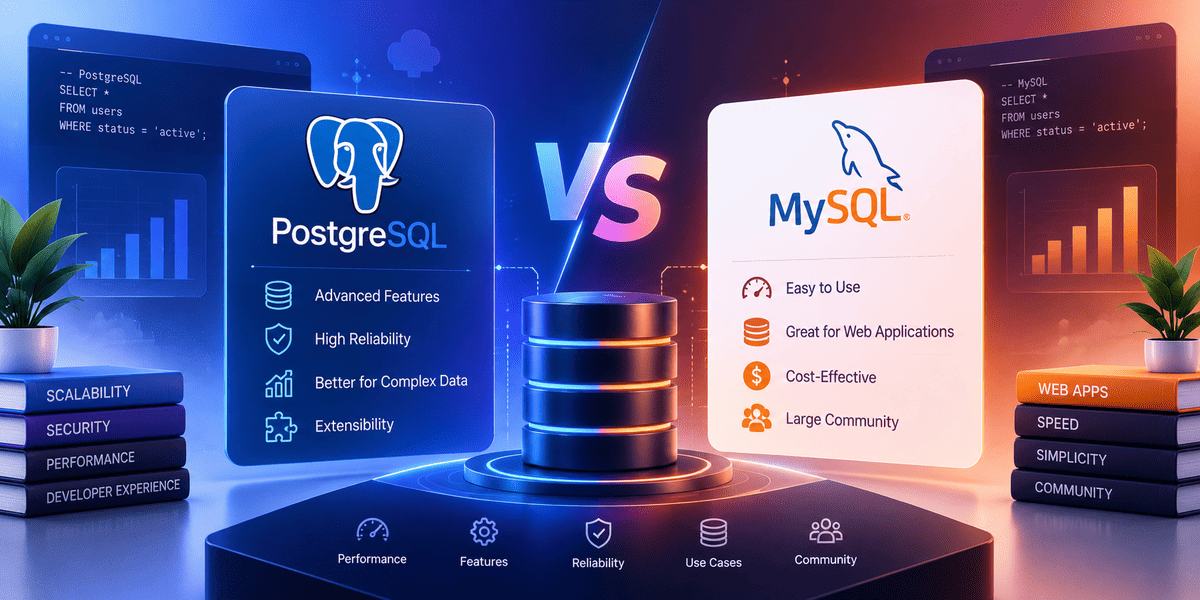
PostgreSQL vs MySQL: The Quick Answer
If you want the short version, here it is.
Choose PostgreSQL when:
- Your data may become complex
- You need advanced SQL queries
- Your app uses a lot of JSON
- You need flexible search options
- Reporting is important
- You expect the product to grow in many directions
Choose MySQL when:
- Your data model is simple
- Your team already knows MySQL
- You want a familiar setup
- You are building a normal web application
- Your current hosting already uses MySQL
- You do not need many advanced database features
Both are good choices.
Your project needs should decide which one you use.
What Is PostgreSQL?
PostgreSQL is an open-source relational database.
Developers often choose it for apps that need complex queries, flexible data types, advanced indexing, and strong data rules.
It is widely used in SaaS apps, data platforms, AI products, business systems, and large web apps.
PostgreSQL also gives developers several ways to work with structured and flexible data.
That makes it useful when a product may change a lot over time.
What Is MySQL?
MySQL is also an open-source relational database.
It has been a popular choice for web development for many years.
A large number of websites, CMS platforms, business apps, and online stores use MySQL.
One of its biggest strengths is familiarity.
Many developers already know how to use it. Most hosting platforms support it. It also works with nearly every major backend language and framework.
For common web apps, MySQL can be simple, stable, and easy to manage.
Both Databases Can Handle Serious Applications
It is easy to think PostgreSQL is only for advanced apps and MySQL is only for simple websites.
That is not true.
Both databases can run production systems.
A normal business application may contain:
- Users
- Customers
- Products
- Orders
- Payments
- Roles
- Reports
Both PostgreSQL and MySQL can handle this type of data.
They also support common database features such as:
- SQL
- Indexes
- Transactions
- Foreign keys
- Joins
- User permissions
- Backups
- Replication
If your app has simple needs, both databases may work well.
The differences become more important as your data and business rules become harder.
PostgreSQL Is Strong for Complex Data
PostgreSQL is often a good choice when the data model becomes complex.
Imagine you are building a SaaS analytics product.
At first, your team may only need a simple report.
For example:
Find all customers who placed an order this month.
Later, the request may become more complex.
You may need to find customers whose spending increased for three months, group them by region, and show the top customers in each group.
That requires more advanced queries.
PostgreSQL works well with this type of data work.
It offers strong support for:
- Complex joins
- Window functions
- Common table expressions
- Custom data types
- Advanced indexes
- Complex filters
MySQL can also handle many advanced queries.
But if I know a project will depend heavily on reporting and complex SQL, PostgreSQL is usually the first option I would review.
MySQL Works Well for Common Web Apps
Not every app needs advanced database features.
Many business apps follow a simple flow.
A user logs in.
They create a record.
They update it.
They view it.
They delete it.
The database stores the result.
MySQL has handled this type of work for many years.
This makes it a good choice for:
- Business websites
- CMS platforms
- Online stores
- Internal tools
- Simple SaaS apps
- Customer portals
If your team already knows MySQL, that is another major benefit.
Your developers may build faster because they already know how to design tables, write queries, fix errors, and manage the database.
PostgreSQL vs MySQL Performance
Which database is faster?
This is one of the most common questions developers ask.
There is no simple answer.
Performance depends on the project.
It can be affected by:
- Database design
- Query quality
- Indexes
- Server resources
- Data size
- Read and write load
- Connection settings
- Caching
- Application code
A badly written PostgreSQL query can be slow.
The same is true in MySQL.
A well-designed application can perform very well with either database.
That is why you should not choose a database based only on one benchmark you find online.
Test your own workload.
Use real data.
Run the type of queries your app will actually use.
That gives you a much better answer.
PostgreSQL vs MySQL for JSON
Modern apps often need to store data that does not fit neatly into fixed columns.
Examples include:
- User settings
- Product details
- API responses
- AI output
- Webhook data
- Event information
- Custom fields
JSON is useful for these cases.
PostgreSQL has strong JSON support.
Its JSONB format is useful when you need to store, search, and index JSON data.
For example, imagine an online store.
Every product may have a product ID, name, price, and status.
Those can stay in normal columns.
But each product may also have different details.
A laptop may have RAM, CPU, and storage.
A shirt may have size, colour, and material.
JSON can help store these extra values.
Does MySQL Support JSON?
Yes.
MySQL also has a native JSON data type.
It can store JSON data and gives developers tools to search and update it.
For many apps, that is enough.
But if JSON is going to be a major part of your product, PostgreSQL may offer more flexibility.
Do Not Store Everything as JSON
JSON is useful.
But it can also be overused.
Data such as these fields should often remain normal columns:
- User name
- Status
- Created date
- Order total
- Product ID
Do not put the whole database record inside one large JSON field only because it feels flexible.
That can make future queries harder.
A simple rule works well.
Use normal columns when the data structure is clear.
Use JSON when the data really needs to change.
Many modern applications use both.
PostgreSQL Offers Strong Indexing Options
Indexes help your database find information faster.
Both PostgreSQL and MySQL support common indexes.
For many web apps, those indexes are enough.
PostgreSQL becomes more useful when your search needs become complex.
That can include:
- JSON searches
- Text searches
- Location data
- Complex filters
- Special data types
You may not need these options when your app is new.
But they can become useful as the product grows.
That flexibility is one reason developers often choose PostgreSQL for products that may become more complex.
PostgreSQL Has a Strong Extension Ecosystem
PostgreSQL can also be extended with extra features.
This is one reason many developers like it.
Extensions can help with areas such as:
- Location data
- Search
- Time-series data
- Vector data
- Special data types
For example, a location-based app may need distance checks and map searches.
PostgreSQL can support these needs through its wider ecosystem.
This does not mean every feature should live inside one database.
Sometimes a separate search tool, cache, or analytics platform is still the better choice.
But PostgreSQL gives you more options before another system becomes necessary.
MySQL Has a Big Advantage: Familiarity
MySQL has been part of web development for a long time.
That matters.
Many developers already know it.
A large number of hosting providers support it.
Many older business systems also depend on it.
That can lead to real benefits:
- Faster development
- Easier debugging
- Fewer setup mistakes
- Easier hiring
- Faster support
- Less learning time
A database does not need the most features to be the right choice.
Sometimes the best database is the one your team already understands well.
PostgreSQL vs MySQL for React and Node.js Apps
React and Node.js developers can work with both databases.
A common app structure looks like this:
React frontend → Node.js API → Database
The React frontend sends requests to the Node.js backend.
The backend then talks to PostgreSQL or MySQL.
Your backend can handle:
- Login
- User permissions
- Data checks
- Business rules
- Database queries
- API responses
From the React side, the database choice may not change much.
Most of the difference appears in the backend.
That is where developers work with queries, data rules, and database tools.
PostgreSQL vs MySQL With Prisma and Other ORMs
Both databases work with popular Node.js tools.
These include:
- Prisma
- Sequelize
- TypeORM
- Drizzle
- Knex
You do not need PostgreSQL only because you use a modern ORM.
You also do not need MySQL because your app uses JavaScript.
Most major tools work with both.
The more important question is whether your ORM supports the database features your app needs.
For simple work, an ORM can save a lot of time.
For a complex report, writing SQL directly may sometimes be easier.
That is normal.
The tool should help your developers rather than limit what the database can do.
Transactions Matter in Real Business Apps
Imagine a customer places an order.
The app needs to:
- Create the order
- Save the items
- Update stock
- Record payment data
- Add reward points
What happens if one step fails?
You do not want half of the order saved.
Transactions help prevent that problem.
Both PostgreSQL and MySQL support reliable transactions when they are used correctly.
The bigger issue is how your application handles them.
Many database problems are caused by poor application logic rather than the database itself.
PostgreSQL vs MySQL for SaaS Products
If I were starting a complex SaaS product, I would often look at PostgreSQL first.
The reason is simple.
SaaS apps tend to become more complex over time.
The first version may only need:
- Users
- Teams
- Plans
- Payments
Later, the same application may need:
- Roles
- Audit logs
- Reports
- Search
- Custom filters
- JSON settings
- AI features
- Analytics
- Integrations
PostgreSQL gives developers a lot of room as these needs grow.
This does not mean MySQL cannot power a SaaS product.
It can.
Many large systems use MySQL.
PostgreSQL simply gives you more options when you expect the product to change often.
PostgreSQL vs MySQL for Simple Business Apps
Now think about a small internal inventory app.
It may include:
- Users
- Products
- Suppliers
- Stock
- Orders
- Reports
The data is clear.
The queries are simple.
Your team already knows MySQL.
In that case, MySQL may be all you need.
There is no reward for using a more advanced database if your current needs are simple.
Good software development is not about choosing the tool with the longest feature list.
It is about choosing the tool that solves the problem well.
Which Database Is Better for AI Apps?
AI apps often store many types of data.
That may include:
- Users
- Conversations
- Messages
- Prompt data
- Model settings
- AI output
- Documents
- Usage logs
- Feedback
- Metadata
PostgreSQL can be a good choice for this type of application.
Its JSON features are useful for flexible AI output.
Its wider ecosystem can also help if your product later needs search, vector data, or more complex data work.
But not every AI app needs PostgreSQL.
If your current product already runs well on MySQL and AI is only one new feature, moving your whole database may not make sense.
Do not create extra work without a clear reason.
Scaling PostgreSQL and MySQL
Both databases can support large apps.
You usually do not need to change databases as soon as traffic grows.
Start by checking the basics.
You may need to:
- Add better indexes
- Fix slow queries
- Use caching
- Add connection pooling
- Reduce extra database calls
- Archive old data
- Add read replicas
- Increase server resources
Many teams worry about millions of users before they have their first few thousand.
That can lead to too much complexity too early.
Build cleanly.
Measure real use.
Then scale when you have a real reason.
Managed Cloud Databases Make Life Easier
Many companies now use managed database services.
They can run both PostgreSQL and MySQL.
A managed database service can help with:
- Backups
- Monitoring
- Updates
- Replication
- Storage
- Failover
This reduces the amount of database work your development team has to manage.
It also means the PostgreSQL vs MySQL decision can focus more on your product needs.
Can You Move From MySQL to PostgreSQL Later?
Yes.
But it may take more work than you expect.
A database move can affect:
- SQL queries
- Data types
- Indexes
- ORM settings
- Backend code
- Reports
- Tests
- Deployment
- Data migration scripts
The larger your app becomes, the harder the migration may be.
If you already know your product needs PostgreSQL features, choosing PostgreSQL from the start may save work later.
If MySQL already solves your needs, there may be no reason to move.
Choose carefully rather than depending on a future migration.
Common Mistakes When Choosing PostgreSQL or MySQL
One common mistake is choosing based on popularity.
A database is not right for your app because it is popular on social media.
Another mistake is trusting one performance test.
Someone else's workload may be very different from yours.
Teams also forget about developer skills.
If your developers know MySQL well, moving to PostgreSQL can add learning time.
The opposite is also true.
Another common mistake is planning for a scale you may never reach.
You do not need to design for hundreds of millions of users on day one.
Build for your real needs while leaving room to grow.
When Should You Choose PostgreSQL?
PostgreSQL may be a better fit when you are building:
- Complex SaaS platforms
- Data-heavy apps
- AI products
- Reporting platforms
- Apps with a lot of JSON
- Location-based apps
- Products with complex filters
- Apps that may change often
The biggest benefit is flexibility.
It gives developers many tools as the product grows.
When Should You Choose MySQL?
MySQL may be the better choice when:
- Your team already knows MySQL
- Your data model is simple
- Your app uses normal CRUD features
- Your hosting setup already uses MySQL
- You have an existing MySQL product
- Moving databases would add risk
In these cases, MySQL can be a very good choice.
Do not change technology only to make your stack look newer.
PostgreSQL vs MySQL: Which Is Better in 2026?
There is no single winner for every project.
For a new product with complex data, I would often start by looking at PostgreSQL.
For a simple web app with a team that already knows MySQL, MySQL is still a strong choice.
PostgreSQL gives developers more flexibility for complex queries, JSON data, indexing, and future data needs.
MySQL gives teams a mature and familiar database with a large ecosystem.
The right choice depends on your project.
Look at your data.
Look at your queries.
Look at your team.
Think about what the product may need in two or three years.
Then choose the database that makes that future easier.
Frequently Asked Questions About PostgreSQL vs MySQL
Which Is Better, PostgreSQL or MySQL?
Both are strong databases.
PostgreSQL is often a better fit for complex data, advanced queries, JSON, and growing SaaS apps.
MySQL can be a good choice for simple web applications and teams that already know it well.
Is PostgreSQL Faster Than MySQL?
Not always.
Database speed depends on your queries, indexes, data size, server setup, and application design.
Both PostgreSQL and MySQL can perform very well when they are set up correctly.
Is PostgreSQL Better for JSON?
PostgreSQL is often a strong choice when JSON is an important part of your app.
Its JSON features give developers flexible ways to store, search, and work with JSON data.
MySQL also supports JSON and may be enough for many common applications.
Is MySQL Still Good in 2026?
Yes.
MySQL remains a practical database for websites, business applications, online stores, SaaS products, and other web systems.
It also has a large developer and hosting ecosystem.
Which Database Is Better for React and Node.js?
Both PostgreSQL and MySQL work well with React and Node.js applications.
React normally communicates with a backend API, while Node.js manages database access.
Your choice should depend more on your backend needs than on React itself.
Which Is Better for SaaS: PostgreSQL or MySQL?
PostgreSQL is often a strong starting point for SaaS products that may need complex queries, reports, flexible data, and new features over time.
MySQL is also capable of running SaaS applications, especially when the data model is more direct.
Which Database Is Better for AI Applications?
PostgreSQL can be useful for AI apps because many AI products work with JSON, flexible metadata, documents, conversations, and other changing data.
However, an existing MySQL application does not need to change databases simply because AI features are being added.
Can I Migrate From MySQL to PostgreSQL Later?
Yes.
But the migration may affect SQL queries, data types, indexes, ORM settings, backend code, tests, and reports.
It is better to consider future needs before the project becomes large.
Is PostgreSQL Harder to Learn Than MySQL?
PostgreSQL may feel more advanced because it provides many extra features.
For basic relational database work, however, both use SQL and share many of the same concepts.
Developers who already understand SQL can learn either database.
Should Startups Use PostgreSQL or MySQL?
Startups should choose based on their product and team.
PostgreSQL is often a good fit when the product may grow into a complex SaaS or data-heavy platform.
MySQL can be a better choice when the application is simple and the team already has strong MySQL experience.
Need Help Choosing the Right Database for Your Application?
The database you choose can affect how easy your product is to build, maintain, and scale.
The right choice is not always PostgreSQL or always MySQL.
It depends on your application, data model, expected growth, development stack, and business needs.
At Infinijith, we help businesses design and build full-stack applications using modern frontend, backend, cloud, and database technologies.
Whether you are building a new SaaS platform, modernising an existing application, or deciding between PostgreSQL and MySQL, our development team can help you choose an architecture that fits your product.
Talk to our full-stack development team and build a database foundation that supports your product today and as it grows.
Final Thoughts
PostgreSQL vs MySQL is not a debate that can be solved with one benchmark.
Both are strong databases.
For a simple application, either may work well.
As the product becomes more complex, the differences start to matter.
PostgreSQL often gives developers more options when queries, JSON, reports, and data models become complex.
MySQL remains a practical choice for common web applications and teams that value familiarity.
The biggest mistake is choosing based on hype.
Your database may stay behind your product for many years.
Choose the one your team understands.
Choose the one that fits your data.
And choose the one that makes your application easier to build, manage, and grow.